Showing posts with label international law. Show all posts

Monday, March 09, 2026


Parts 1 through 3 built the diagnostic and prescriptive framework. The West's episodic war theory is a category error. Revolutionary movements identified that error and built a doctrine around exploiting it. We need to handle adversarial reality considerably better than what international law currently provides.

The question is, what should international law look like, or does it even make sense? 

The first thing to say clearly is this: international law is a procedural system, not a moral one. It is a coordination mechanism among sovereign states, designed to manage conflict, reduce escalation, and create predictable expectations of behavior. What it does not do, despite the moral language that constantly surrounds it, is adjudicate right and wrong.

Terms like "war crimes," "international justice," and "the rules-based order" carry enormous moral weight in public discourse.  They imply that legal compliance tracks moral legitimacy and legal violation tracks moral culpability. But the system's enforcement depends almost entirely on political power and consent. Its institutions are manipulated by the states that fund them. Its definitions are negotiated by parties with interests in the outcomes.

The UN couldn't agree on a definition of terrorism because too many member states wanted their favored terror groups excluded. Syria used chemical weapons repeatedly while sitting on the Security Council. The International Criminal Court pursued Israeli commanders while Hamas leadership walked free. This is the system operating exactly as its political structure predicts. 

In other words, there is a huge gap between what is legal and what is moral. Things that are legal (like Iran's ballistic missile program) can be immoral, and things that are moral (like the Osirak strike) may be considered illegal. 

Updating international law cannot work. The problem isn't technical, it's structural. Any reform flexible enough to address the capability-threshold problem and the continuous-war doctrine is also flexible enough to be claimed by Russia against Ukraine, by China against Taiwan, by Iran against Israel. The universality that gives international law its legitimacy is precisely what makes it unreformable for this class of problem. You cannot write a rule that applies to everyone and have it apply only to good-faith actors.

The deeper issue is that universal legal systems have a scaling problem. A system that must govern hundreds of states with radically different traditions, threat environments, and political structures cannot be both universal and morally serious simultaneously. The attempt to make it both produces exactly what we have - universal enough to be hijacked, morally serious enough to weaponize as language, neither in practice.

The solution is not a better universal system. It is a different architecture entirely. 

The proposed solution has two parts.

There needs to be a system where there is a basic set of laws that everyone can agree upon, like not targeting civilians, prohibiting weapons of mass civilian destruction, and not murdering prisoners of war.  They are universal because they represent the floor below which no war doctrine can descend without forfeiting moral standing entirely, and every serious tradition knew this before any convention was signed.

But above that, each state publishes their own laws of war. Most states do this already - they have military manuals that go into detail as to what they can and cannot do. States must make these regulations and policies public and transparent, and they should be judged against them. 

Pluralism is more realistic than universalism. Even today, there is a reason every country has its own published rules of war: there are always specific circumstances that apply to individual countries.  It is the honest recognition that different states, different traditions, and different threat environments produce legitimately different doctrines - and that this diversity is preferable to a false universalism that the most ruthless actors exploit most effectively.

What makes pluralism workable rather than anarchic is transparency and self-accountability. Each state develops and publicly declares its own laws of war. Those declarations are public and criticizable. Each state is held accountable — by its allies, by its citizens, by history — against its own declared standards, not against a universal standard negotiated by parties with conflicting interests.

Voluntary treaties and signed conventions carry genuine moral obligation within this framework, because consent creates responsibility in a way that imposition does not. A state that signs the Chemical Weapons Convention and violates it is culpable in a way that a state operating outside a framework it never accepted is not.

If states voluntarily decide to be subject to rulings of the ICC, that is fine. But states that do not should not be penalized by than decision. 

International law functions as a reference point — a repository of accumulated wisdom about how wars should be fought — not as a moral authority whose pronouncements supersede national survival. The ICRC can (and does) publish its own interpretation of the laws of armed conflict; it should be used as a reference but not as canon. Every state can specify which parts they disagree with and why. 

You may ask, if states declare their own laws of war, what prevents a state from simply declaring chemical weapons, torture, or deliberate civilian targeting legitimate? Doesn't that dissolve the floor entirely?

Two mechanisms within the framework itself answer this, with no external enforcement required.

First: a declaration that violates the irreducible floor is itself a casus belli. This follows directly from the relational framework established in Part 3. Declared hostile intent combined with capability constitutes a state of war in Locke's sense. A state that publicly declares its intention to use weapons designed purely for mass civilian suffering has announced something about its relationship to every other state simultaneously. That declaration, combined with possession, already meets the threshold criteria. No tribunal is required, the transparency requirement enforces itself: your public doctrine has consequences you cannot later disclaim.

Second: states may include exception clauses in their own declared doctrines when dealing with enemies who themselves violate accepted rules. If observing a specific protection systematically disadvantages you against an enemy who deliberately exploits that protection as a weapon, you may relax that specific protection to the degree necessary to restore operational parity, but no further. 

Hamas fires from hospitals, stores weapons in schools, and uses civilian infrastructure as deliberate military cover, meaning Israel's genuine commitment to protecting those sites becomes a tactical asset for Hamas, not a protection for civilians. In that specific context, the protection can be adjusted — not eliminated, but recalibrated to account for the systematic exploitation, with evidence, proportionality, and public justification.

An enemy that consistently uses white flags as deception reduces the operational presumption of surrender — not eliminates it, but adjusts the evidentiary threshold required before extending it.

This is not carte blanche for a nation to ignore accepted rules if their enemies do. If one side uses chemical weapons against civilians that does not mean the other side can do the same. But if one side weaponizes civilians or humanitarian symbols or religious sites, the other side can justify attacking them. 

The exception clause invocation is never self-executing. It must be publicly justified — against the adversary's own declared doctrine, demonstrated behavior, and the specific operational disadvantage being created. The evidentiary burden is high, visible, and applied to the specific protection being adjusted, not to the laws of war generally. The claim is either sustained by the record or exposed as false by it.

This framework  gives precise, evidence-based, proportionate adjustment to specific protections that have been systematically converted into weapons — and it requires you to show your work publicly.

This is not perfect. It can still be abused. Catching deception is not easy. But we have that situation today as well. The advantage here is not to treat international law as a moral system when it can be used for immoral purposes. A nation that hides its crimes invites others to demand answers - or suffer consequences. Transparency helps a great deal here.

Iran's revolutionary doctrine is public. It declares permanent hostility toward Israel and the United States as a founding constitutional principle, endorses proxy warfare, deliberately targets civilians through those proxies, and has consistently pursued weapons of mass destruction as instruments of that struggle. Judged against its own declared standards, Iran has placed itself outside the irreducible floor. The declaration is its own condemnation.

Israel's military doctrine is public, detailed, and rigorously applied. It requires distinction between combatants and civilians, proportionality relative to military objectives, warnings before strikes where operationally possible, and investigation of alleged violations. Israel has a functioning military legal system that has prosecuted soldiers for violations of its own standards. Judged against its own declared doctrine, Israel's conduct reflects genuine structural commitment to fighting within a serious ethical framework under conditions deliberately engineered to make that commitment costly.

These are not morally equivalent positions. The current system treats them as if they are. An honest framework makes the difference visible and lets the record speak.

There is no institutional solution to a world containing genuinely malign actors with veto power. The existing system's pretense that institutions solve this problem is precisely what revolutionary movements have spent decades exploiting.

Right now, the international law system has been politicized and hijacked. Strong states do whatever they want anyway, and terrorist states hide behind the law. 

A theory of law must be based on reality. The only way this can happen is if the malign actors are forced to be transparent about their policies and others can act accordingly.

Law is not morality. But morality must govern what laws we build - and anticipate how they will be perverted by those who treat them as weapons rather than obligations


Buy EoZ's books  on Amazon!

"He's an Anti-Zionist Too!" cartoon book (December 2024)

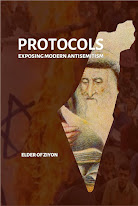
PROTOCOLS: Exposing Modern Antisemitism (February 2022)


Sunday, March 08, 2026

By Daled Amos


“Victory smiles on those who anticipate the changes in the character of war, not upon those who wait to adapt themselves after the changes occur.” 
Italian Air Marshall Giulio Douhet, quoted by David Micah Stark in The Modern Character of War: A Reexamination of the Law of Armed Conflict

Those changes are in the process of happening now, right before our eyes.

Trump has described the ongoing American campaign as a “combat operation” rather than a formal war. Yet whatever you call it, this conflict is already raising questions about the modern laws of war as we know them: What does proportionality mean when a state targets civilians in countries that want to stay on the sidelines? When is a threat truly “imminent” in the age of nuclear weapons and long-range missiles? And how should democratic states respond to enemies who deliberately wage war through terrorism?

Iran Redefines Proportionality


The current Iranian president, Masoud Pezeshkian, apparently apologized for the missile and drone attacks against its Arab neighbors--including the UAE, Saudi Arabia, Bahrain, Qatar, Oman--and Cyprus, which is associated with Europe.

But he soon backtracked in a post on X, claiming Iran only targets US bases:

But that is not true.

Civilian targets have also been hit: Dubai's main airport in the UAE, liquefied natural gas facilities in Qatar, the Ras Tanura refinery in Saudi Arabia, the Bapco Energies refinery in Bahrain, and assorted ports and hotels in the Gulf. This is no accident. The attacks reflect a broader Iranian strategy that Iran threatened last month, as reported by the Wall Street Journal:
Ahead of the last round of nuclear talks in February, national security council chief Ali Larijani passed a letter to the U.S. via Oman saying Iran would no longer respond proportionally and would react aggressively to any attack, they said. “The Americans must be aware that if they wage a war this time, it will be a regional war.”
Proportionality, a term regularly brought up to accuse Israel of violating international law whenever it responds to attacks, has so far been absent from discussion about the current conflict. But Iran is in fact attacking Arab countries that are not actively involved in the attack, and is firing at civilian targets as well.

How long will the international community sit back and accept this?

(It is important to distinguish between two very different uses of the word “proportionality.” In international law governing the conduct of hostilities, proportionality refers to the requirement that commanders avoid attacks in which expected civilian harm would be excessive relative to the concrete military advantage anticipated. Nothing about Israel’s evolving strategy changes that legal obligation. The shift being discussed here concerns a different concept: the older assumption that military responses should mirror the scale of the initial attack rather than aim to remove the broader threat.  -EoZ)

The US Redefines "Imminent Threat"


Trump's initiation of this attack raises another issue under the law of war: imminent threat. Critics have claimed that there is none, but Trump has been adamant from the start
Earlier Saturday, Trump said that the United States had faced “imminent threats from the Iranian regime.” Tehran was continuing to work toward producing a nuclear weapon and development of “long-range missiles that … could soon reach the American homeland.”
This debate is part of a deeper problem. Traditionally, threats developed slowly and were visible well in advance. But today, nuclear programs, ballistic missile technology, and proxy terrorist networks operate on a very different timeline.

Israel’s experience illustrates the dilemma. Israel cannot afford to wait for Iran to attack first. Reuel Marc Gerech and Ray Takeyh write in the Wall Street Journal:
An Israeli consensus has developed: The Jewish state will have a continuous need to degrade the clerical regime’s proxies and home defenses, which could shield revitalized nuclear and ballistic-missile programs. Threats no longer have to be imminent to be countered. [emphasis added]
Israel does have to wait for an Iranian leader to have his finger on the button before reacting to the threat of a nuclear Iran. And the long history of Iranian hostility to the US, including the 1979 hostage crisis, the 1983 Beirut Barracks Bombing, the 1996 Khobar Towers Bombing in Saudi Arabia, and the hundreds of US soldiers killed by Iranian EFPs and IEDs in Iraq, shows that the US is in a similar situation. Barton Swain rebuts the claim that Iran does not pose an imminent threat:
As for [Sen. Tim Kaine's] denial that the threat was “imminent,” I wonder what the word could mean: Iran has attempted to assassinate assorted American dignitaries, including the president. It funds terror groups across the Middle East and slaughtered 30,000 demonstrators a few weeks ago. Its rulers express Nazi-like ambitions of annihilating its enemies, even as they don’t bother to hide a mad hunger for long-range missiles and nuclear technology.

Waiting until the danger is literally moments away may no longer be a defensible strategy. 

Israel Redefines Proportionality 

Israel, meanwhile, is redefining proportionality in a different way. 

Unlike Iran, Israel is not holding its neighbors hostage in an attempt to blackmail the US into a draw. Amit Segal writes about what he calls The New Israeli Rules of Engagement, pointing out that "Proportionate’ responses are a thing of the past. Now we understand we can’t live with terrorists." Terrorism is a form of warfare that has yet to be adequately addressed by international law. It is a form of warfare that exploits the protections of international law while violating them. Before October 7, Israel limited itself to carefully calibrated strikes against Hamas that would avoid escalation. Instead, the strategy produced the opposite effect: attacks against Israeli civilians became a regular occurrence.

 Israel came to the conclusion that you don't mow the grass; you remove it:
When you respond, overwhelm your foe. For years, the enemy fired rockets and Israel replied with “proportional” force. This normalized the firing on civilians, kidnapping and invasion. But this changed after Oct. 7. Hezbollah leader Hassan Nasrallah thought he was still playing by the old rules, launching a few rockets daily. It ended with his elimination, the decapitation of his organization, and the destruction of 80% of their missile stockpile.

This new approach does not only apply to proxies like Hamas in Gaza and Hezbollah in Lebanon. This policy also applies to their sponsor. Iran established and backed these threats and will have to be dealt with the same way:

The Jewish state can’t accept the existence in Iran of production facilities and thousands of ballistic missiles, with every launch sending half of Israel into shelters and threatening mass casualties. It can’t tolerate a regime that continues, even today, to fund its greatest enemies with more than a billion dollars annually.

The actions Iran is now taking against its neighbors, attacking airports, hotels, and refineries, demonstrate just how right Israel is. 

Historically, war has always forced nations to revise the rules that govern it. Over the past week, we have seen Tehran demonstrate its own interpretation of “proportionality” by targeting civilian infrastructure and threatening to widen the war across the region. Israel, facing terrorists who don't even abide by international law, has found that the old doctrine of proportional responses only guarantees perpetual attack. Meanwhile, the US is confronting a similar dilemma of whether the concept of “imminent threat” can still apply in an era of nuclear proliferation, ballistic missiles, and terrorist proxies.

Let's face it. The character of war has changed. States confronting regimes that openly seek their destruction cannot wait for the perfect legal threshold before acting. It is time for international law to account for this new strategic reality where deterrence, preemption, and decisive force may be the only way to avoid catastrophe.


Buy EoZ's books  on Amazon!

"He's an Anti-Zionist Too!" cartoon book (December 2024)

PROTOCOLS: Exposing Modern Antisemitism (February 2022)


Thursday, June 06, 2024


Human Rights Watch issued another report accusing Israel of violating international law by using white phosphorus in Lebanese towns.

White phosphorus is a chemical substance dispersed in artillery shells, bombs, and rockets that ignites when exposed to oxygen. Its incendiary effects inflict death or cruel injuries that result in lifelong suffering. It can set homes, agricultural areas, and other civilian objects on fire. Under international humanitarian law, the use of airburst white phosphorus is unlawfully indiscriminate in populated areas and otherwise does not meet the legal requirement to take all feasible precautions to avoid civilian harm.

... Lebanon should promptly file a declaration with the International Criminal Court (ICC), enabling the investigation and prosecution of grave international crimes within the court’s jurisdiction on Lebanese territory since October 2023.

The wording is carefully chosen . WP is not an incendiary weapon nor is it a chemical weapon, which have very specific definitions under international law. It is a legal weapon used by major militaries including the US. But HRW makes sure to use the words "incendiary" and "chemical" to give the impression that white phosphorus is an illegal weapon.

HRW counts 17 alleged incidents of Israel using WP in populated areas. Yet, it admits, "Human Rights Watch did not obtain evidence of any burn injuries resulting from the use of white phosphorus munitions but heard accounts indicating possible respiratory damage."

If white phosphorus' main problem is that it can burn people, and not one case of anyone being burned was found, then it appears that Israel is using the weapon responsibly (if indeed this is white phosphorus and not a similar smokescreen.)

Unlike Human Rights Watch, the Lieber Institute at West Point goes into detail on the legality of using white phosphorus, and finds that it is quite legal, as long as it is not used to violate other laws of war like the principle of proportionality.. In fact, its legal use is far more expansive than HRW claims. Israel uses it for smokescreen and marking; but international law allows it to be used to directly attack enemy militants. 
There is no per se prohibition on the use of white phosphorous. For instance, a March 2009 HRW report notes that “[w]hen used properly in open areas, white phosphorous munitions are not illegal.” A 2017 article in the New York Times likewise noted that “it is not illegal under international law for militaries to possess and use white phosphorus.” The military manuals of several States indicate that it may be used lawfully, even as an anti-personnel weapon, in certain circumstances (e.g., United States (§ 6.14.2.1), Canada (para. 521.3.), France (p. 20-21), Germany (paras. 453-458), and Australia (paras. 4.30-31)). The question, then, is whether the use of white phosphorous munitions is restricted by weapons treaty law or the law of armed conflict rules governing the conduct of hostilities.
....[E]ven if white phosphorous munitions did qualify as “incendiary weapons,” Protocol III would not ban their use. Rather, it regulates the use of incendiary weapons by parties to the instrument for the purpose of protecting civilians.

The US Army War Manual says "[W]hite phosphorus may be used as an antipersonnel weapon. However, such use must comply with the general rules for the conduct of hostilities, including the principles of discrimination and proportionality.In addition, feasible precautions to reduce the risk of harm to civilians must be taken." 

Israel says it only uses shells with WP in urban areas under very specific (undisclosed) circumstances that have been approved by Israel's High Court. While the specific use cases are secret, we could get some clues from the footnotes in the US Army Manual, which says the army used white phosphorus in urban areas in Fallujah directly against terrorists: "We used it for screening missions at two breeches and, later in the fight, as a potent psychological weapon against the insurgents in trench lines and spider holes when we could not get effects on them with HE [High Explosive]. We fired ‘shake and bake’ missions at the insurgents, using WP to flush them out and HE to take them out.

The Lieber article quotes the Protocol on Prohibitions or Restrictions on the Use of Incendiary Weapons, which says that even as an incendiary weapon, it is permitted "when such military objective is clearly separated from the concentration of civilians and all feasible precautions are taken with a view to limiting the incendiary effects to the military objective and to avoiding, and in any event to minimizing, incidental loss of civilian life, injury to civilians and damage to civilian objects.

The Lieber article concludes, "The application of the law of armed conflict to the use of white phosphorus munitions must be done on a case-by-case basis. Like the use of any munition in combat, whether the use of white phosphorous munitions is lawful depends on the attendant circumstances." HRW cannot point to any illegal use of WP in Lebanon, and says that it does not know if there were any Hezbollah military targets in the areas where it was used. Even the implication that Israel would use WP without any Hezbollah targets - meaning, aiming it at civilians or using it indiscriminately  - is slanderous and nonsensical, not to mention that it shows that HRW knows nothing about the layers of review the IDF goes through in making decisions on types of weapons used in targeting. 

HRW's report can be summarized as "we cannot find that Israel did anything wrong, but it's Israel, so they must have."

There is a further irony here. The same day that HRW released this report, there are major forest fires in Israel's north sparked by Hezbollah weapons. If Hezbollah deliberately tried to set these fires and used munitions designed for that purpose, they would be violating the same prohibition on incendiary weapons HRW pretends Israel is violating. The same Protocol mentioned earlier says, "It is prohibited to make forests or other kinds of plant cover the object of attack by incendiary weapons except when such natural elements are used to cover, conceal or camouflage combatants or other military objectives, or are themselves military objectives."

Palestinians have deliberately set Israeli forests and fields on fire from the 1920s to today.. Some believe the current wildfires were purposefully set. The amount of damage to civilian property in Israel from fires dwarfs that from WP in Lebanon. 

But you can be very sure that Human Rights Watch is not going to write a report accusing Hezbollah of violating the same protocol they accuse Israel of violating. 


Buy the EoZ book, PROTOCOLS: Exposing Modern Antisemitism  today at Amazon!

Or order from your favorite bookseller, using ISBN 9798985708424. 

Read all about it here!


Monday, October 23, 2023


How do we know Amnesty International is antisemitic?

I once listed 15 separate reasons, examples of egregious Amnesty bias and lies about Israel.  And I could have listed dozens more. 

Here's yet another.

Amnesty released a report on the early part of Israel's bombing campaign against Hamas. 

The Israeli army claims it only attacks military targets, but in a number of cases Amnesty International found no evidence of the presence of fighters or other military objectives in the vicinity at the time of the attacks. Amnesty International also found that the Israeli military failed to take all feasible precautions ahead of attacks including by not giving Palestinian civilians effective prior warnings – in some cases they did not warn civilians at all and in others they issued inadequate warnings.

“Our research points to damning evidence of war crimes in Israel’s bombing campaign that must be urgently investigated. Decades of impunity and injustice and the unprecedented level of death and destruction of the current offensive will only result in further violence and instability in Israel and the Occupied Palestinian Territories,” said Agnès Callamard.

“It is vital that the Office of the Prosecutor of the International Criminal Court urgently expedites its ongoing investigation into evidence of war crimes and other crimes under international law by all parties. Without justice and the dismantlement of Israel’s system of apartheid against Palestinians, there can be no end to the horrifying civilian suffering we are witnessing.”
These three paragraphs show that culminate in the "apartheid" libel which has nothing to do with Gaza proves that Amnesty's aim is dismantling Israel, not justice for Gazans.

If Amnesty does not know the targets of the attack, then it cannot call the attacks unlawful. In the past I've documented scores of cases where Amnesty claims that only civilians were killed and weeks later terror groups published the names of their members killed in the same attacks. 

The fact is that Amnesty is clueless as to what the real targets were. If the targets were senior Hamas members, then no warnings could or should have been given. 

That is real international law, not the fabricated version Amnesty pretends exists.

Amnesty's methodology is to interview survivors who claim that there were no terrorists around,. Often these people are lying, and sometimes these people are themselves members of terror groups!

Moreover, when Amnesty publishes these reports, it doesn't even consider that a professional army would not shoot expensive  precision weapons at civilians for no reason. No, Amnesty thinks it can read the IDF's minds, and knows that there was no possible reason for the attack. To Amnesty, the IDF - with multiple layers of checks and balances, lawyers reviewing every target and every airstrike, and approvals needed at all levels - is just randomly attacking civilians. 

Amnesty's track record of investigating these types of events is beyond awful. It shows a pattern where Palestinians are believed without question without even Googling their names, and where Israeli denials are assumed to be lies. 

Even worse, an Amnesty researcher has admitted that Palestinian "eyewitnesses" often lie.  But they haven't changed their methodology of believing their lies implicitly. 

Beyond that, Amnesty never mentions that Gazans would be punished by Hamas if they were known to be saying anything Hamas doesn't like. That is a salient fact when they quote Gazans but Amnesty doesn't want anyone to know that. 

That, ladies and gentlemen, is beyond sloppiness and beyond ignorance of how modern warfare works. That is antisemitism - assuming malicious intent from Jews and nothing but the truth from those with  a long track record of lying to Amnesty. 


Buy the EoZ book, PROTOCOLS: Exposing Modern Antisemitism  today at Amazon!

Or order from your favorite bookseller, using ISBN 9798985708424. 

Read all about it here!


Wednesday, October 18, 2023

By Daled Amos

These days, when people talk about what International Humanitarian Law requires in the aftermath of the Hamas massacre of Israeli citizens, the discussion falls first on what limitations need to be placed on Israel. Almost as an afterthought do a few people ask what international law requires of Hamas.

That in itself demonstrates an odd sense of priorities among the global community.

But a third topic in international law is being ignored, namely: what are the obligations of the international community in the face of this terrorist attack. By merely sitting back and focusing on Israel's obligations, the nations of the world run the risk of themselves violating international law.

First of all there is the Genocide Convention. It was approved for ratification by the UN General Assembly in 1948 and went into effect in 1951. According to Article I:
The Contracting Parties confirm that whether committed in time of peace or of war, genocide is a crime under international law which nations are obligated to prevent and to punish.
The convention addresses an act committed with the intent to destroy, even in part, a
national
o  ethnical
o  racial or
o  religious group
Genocide includes -- among other things -- killing members of the group, causing serious bodily or mental harm and deliberately inflicting conditions with the intent to cause the group's physical destruction in whole or in part. In addition to being directly involved in the genocide, this law also applies to conspiracy, incitement, complicity and even the mere attempt to commit genocide. In addition, the convention not only rulers but also public officials and private individuals liable for punishment.

Then there is UN Security Council Resolution 1373 (2001), which was passed in response to the jihadist attack on 9/11, making this resolution especially relevant to the current situation, given the obvious similarities. It was passed under Chapter 7 of the UN Charter, making it binding on all UN members, unlike other UN resolutions.

According to Article 2, All States shall:
(a) Refrain from providing any form of support, active or passive, to entities or persons involved in terrorist acts, including by suppressing recruitment of members of terrorist groups and eliminating the supply of weapons to terrorists;

(c) Deny safe haven to those who finance, plan, support, or commit terrorist acts, or provide safe havens;

(e) Ensure that any person who participates in the financing, planning, preparation or perpetration of terrorist acts or in supporting terrorist acts is brought to justice and ensure that, in addition to any other measures against them, such terrorist acts are established as serious criminal offences in domestic laws and regulations and that the punishment duly reflects the seriousness of such terrorist acts;
According to Article 3, All States shall:
(f) Take appropriate measures in conformity with the relevant provisions of national and international law, including international standards of human rights, before granting refugee status, for the purpose of ensuring that the asylum seeker has not planned, facilitated or participated in the commission of terrorist acts;

(g) Ensure, in conformity with international law, that refugee status is not abused by the perpetrators, organizers or facilitators of terrorist acts, and that claims of political motivation are not recognized as grounds for refusing requests for the extradition of alleged terrorists;
Furthermore the resolution
5. Declares that acts, methods, and practices of terrorism are contrary to the purposes and principles of the United Nations and that knowingly financing, planning and inciting terrorist acts are also contrary to the purposes and principles of the United Nations;
On Sunday, Caroline Glick spoke with Professor Avi Bell -- an expert in International Law -- about the legal obligations of the rest of the world in response to the Hamas terrorist attack, and how nations are violating those obligations. Some of his insights are summarized in a JNS article published yesterday.

Bell makes reference to UN Security Council Resolution 1373, and illustrates how some of its requirements are being violated. For instance:
Resolution 1373 stipulates that all U.N. member nations must “Refrain from providing any form of support, active or passive, to entities or persons involved in terrorist acts.”

Any provision of any aid to Gaza, which is completely controlled by Hamas, is of course either “active or passive” assistance to Hamas, and hence illegal.
This puts the claims of the obligation to provide humanitarian aid to Gazans in a different light, considering how Hamas terrorists are sure to take - and have taken - the aid for themselves.

Professor Bell also points out how Qatar's involvement, supported by the Biden administration, is also in violation of Resolution 1373:
Resolution 1373 also requires all U.N. member states to “Deny safe haven to those who finance, plan, support or commit terrorist acts, or provide safe havens.”

Following Blinken’s visit to Israel last Thursday, he traveled to Qatar. Qatar houses Hamas’s top terror masters. They planned their atrocities from Qatar. Iran’s cash and arms are funneled to Hamas through Qatar. Qatar’s Al Jazeera satellite channel is an integral component of Hamas’s terror machine. On Monday morning, the IDF announced that Al Jazeera reporters are transferring information about IDF troop placements and numbers to Hamas both directly and through their broadcasts...

By embracing Qatar as an ally rather than punishing it for its central role at all levels of Hamas’s terror infrastructure, the administration is breaching international law, yet again. It is also betraying Israel.
Like Resolution 1373, article VII of the Genocide Convention also addresses the issue of extradition:
Genocide and the other acts enumerated in article III shall not be considered as political crimes for the purpose of extradition. 

The Contracting Parties pledge themselves in such cases to grant extradition in accordance with their laws and treaties in force.
This becomes relevant because CDR David Levy writes about Hamas Leadership and America’s Extradition Option for The Begin-Sadat Center For Strategic Studies:
EXECUTIVE SUMMARY: Hamas has conducted the most devastating terror attack in Israel’s history, demonstrating humanity’s worst depravity. The attack led to the tragic loss of over 1,200 lives, including at least 22 Americans, with many more individuals held hostage. The US has a responsibility to its citizens to demand the extradition of Hamas leadership to face trial in the US. Drawing upon precedent and previous successful extraditions of international terrorists, the US can leverage diplomatic relationships and military assets to actively pursue their extradition from Qatar, Lebanon, or other locations where they may reside. [emphasis added]
Levy writes that the fact that the US does not have an extradition treaty with Qatar does not have to make it impossible to get that country to hand over the terrorist leaders:
The US does not have extradition agreements with Qatar or Lebanon, but it has leverage. In requesting extradition from Qatar, Washington has some influence over Doha. Initially, Doha will almost certainly not accept. However, the US can orchestrate the desired outcome with a well-constructed “carrot and stick” approach. The US has a significant military presence in Qatar, including the Al Udeid Air Base, a crucial regional strategic asset. The future of this base and broader military cooperation, such as access to military sales, could be used as a bargaining chip. Economic levers could offer incentives like future trade deals or impose targeted sanctions against individuals or entities. Also, the US can endeavor to work with other allies, like Saudi Arabia and Turkey, to influence Qatar.
The article details examples of the US "holding those responsible for the deaths of its citizens accountable" and Levy brags that this is part of a long-standing US tradition. The article would be more convincing if we had not seen the failure of multiple administrations to apply the necessary leverage to get Jordan to hand over the mastermind of the Sbarro massacre, responsible for 16 deaths, including 2 Americans.

If a country like the US will not apply international law for itself, what are the odds we will see any country apply international law for others?


Buy the EoZ book, PROTOCOLS: Exposing Modern Antisemitism  today at Amazon!

Or order from your favorite bookseller, using ISBN 9798985708424. 

Read all about it here!


Monday, October 16, 2023


Ken Roth, the former Human Rights Watch head, tweeted:

"International humanitarian law prohibits collective punishment of...protected persons for acts committed by individuals during an armed conflict. The imposition of collective punishment is a war crime." -- Red Cross @ICRC
He gave the source  from the ICRC - and it proves the opposite  of his attempt to paint Israel as guilty.

The first paragraph, which he skips, defines collective punishment:
The term refers not only to criminal punishment, but also to other types of sanctions, harassment or administrative action taken against a group in retaliation for an act committed by an individual/s who are considered to form part of the group. Such punishment therefore targets persons who bear no responsibility for having committed the conduct in question.
The word "retaliation" makes it sound as if the action must be done deliberately as a punishment, not as a consequence of going after the actual guilty party.

For example, if a terrorist group gets its arms flown in on flights t a commercial airport, a nation can bomb that airport runway - even if it means that legitimate airplanes cannot land. It definitely affects innocent people but it is not collective punishment, because that is not the intent. 

Similarly, other dual use targets - power stations, TV and radio broadcast stations - may be attacked if they are also used by the combatant. (All of these are subject to proportionality analysis, as with any military action.)

Looking at specific legal rulings listed the ICRC, we see that collective punishment was defined quite clearly by the Special Court for Sierra Leone:

224. The Appeals Chamber finds that the correct definition of collective punishments is:
i) the indiscriminate punishment imposed collectively on persons for omissions or acts for which some or none of them may or may not have been responsible;
ii) the specific intent of the perpetrator to punish collectively.
Although sometimes individual politicians have said stupid things in the heat of argument, but Israel has made it clear in its policy and actions that it has no intention of hurting the Gaza population for anything Hamas has done. 

This brings up a bigger question. In many points of international law, such as the principle of distinction, proportionality and even genocide,  the intent of the parties is paramount in determining guilt. No one is a mind reader so the only evidence we have on intent is the actions - if they can be explained without resorting to malicious intent, then such intent should not be assumed. On the other hand, if there are other examples where the malice is clear, due to what parties said or because their other actions leave no other explanation, then one can assume the intent is malicious. 

With Israel, NGOs and people like Ken Roth always assume malicious intent - which they have never done for Hamas. 

This is how people can quote international law to damn Israel. Even when they quote everything accurately, they are assuming Israel is breaking the rules and therefore they interpret intent in that way.

And if you automatically assume that only the Jewish state has malicious intent against civilians in war, especially when there are thousands of counterexamples that prove otherwise, that pretty much make you an antisemite.


Buy the EoZ book, PROTOCOLS: Exposing Modern Antisemitism  today at Amazon!

Or order from your favorite bookseller, using ISBN 9798985708424. 

Read all about it here!


Thursday, October 12, 2023

By Daled Amos

The outpouring of sympathy and concern from around the world in reaction to the massacre of Israeli men, women and children by Hamas terrorists is welcome and appreciated.

But we are talking about Israel, so we knew that it would only be a matter of time -- after Israel struck back -- than some of that sympathy would dry up. More than that, critics are now claiming that Israel is the villain and is guilty of war crimes because of its efforts to remove the dangerous threat of Hamas.

Specifically, in an effort to not only get rid of Hamas but also save the hostages being held by the terrorists, Israel is imposing a siege -- and the West is crying foul.

The reasoning for the condemnation is that by cutting off water and electricity, Israel is supposed to be guilty of violating international law due to the collateral damage caused to Gazans. The problem of course is that while critics of Israel enjoy throwing around phrases like "international law," "genocide," and "war crime" they do this without knowing -- or caring -- what these terms actually mean.

The legal issue here is the concept of siege.

The US Law of War manual summarizes the legality of a siege in warfare:
It is lawful to besiege enemy forces, i.e., to encircle them with a view towards inducing their surrender by cutting them off from reinforcements, supplies, and communications with the outside world.  In particular, it is permissible to seek to starve enemy forces into submission. 

Article 23 of the Geneva Convention (IV): Consignment of medical supplies, food and clothing says:
Each High Contracting Party shall allow the free passage of all consignments of medical and hospital stores and objects necessary for religious worship intended only for civilians of another High Contracting Party, even if the latter is its adversary. It shall likewise permit the free passage of all consignments of essential foodstuffs, clothing and tonics intended for children under fifteen, expectant mothers and maternity cases.

The obligation of a High Contracting Party to allow the free passage of the consignments indicated in the preceding paragraph is subject to the condition that this Party is satisfied that there are no serious reasons for fearing:
(a) that the consignments may be diverted from their destination,

(b) that the control may not be effective, or

(c) that a definite advantage may accrue to the military efforts or economy of the enemy through the substitution of the above-mentioned consignments for goods which would otherwise be provided or produced by the enemy or through the release of such material, services or facilities as would otherwise be required for the production of such goods.

The key point is that while supplies are not to be automatically held up from the enemy, international law recognizes that this is subject to exceptions where those consignments may be diverted or aid the adversary's military efforts. Concrete for underground tunnels and piping used for rockets come to mind.

Then there is Customary International Humanitarian Law, rules based on general practice that has become accepted as law and is independent of treaty law.

According to Rule 53, The use of starvation of the civilian population as a method of warfare is prohibited. That being the case, how can Israel apply a siege on Gaza?

The answer is that those who blindly claim that Israel is violating International Law by using a siege just don't know what they are talking about:

Sieges that cause starvation

The prohibition of starvation as a method of warfare does not prohibit siege warfare as long as the purpose is to achieve a military objective and not to starve a civilian population. This is stated in the military manuals of France and New Zealand. Israel’s Manual on the Laws of War explains that the prohibition of starvation “clearly implies that the city’s inhabitants must be allowed to leave the city during a siege”. Alternatively, the besieging party must allow the free passage of foodstuffs and other essential supplies, in accordance with Rule 55. States denounced the use of siege warfare in Bosnia and Herzegovina. It was also condemned by international organizations.

Israel's goal is not to cause starvation to civilians. The goal it to achieve the release of the hostages kidnapped by the terrorists and get rid of Hamas. As far as allowing "the free passage of foodstuffs and other essential supplies," we saw above in Article 23(c) that international law recognizes the advantage gained by an enemy that is relieved of the responsibility for providing for its citizens -- plus there is an obvious concern that Hamas would take the supplies for itself. Recall that the consignments are to be intended for children under 15.

Now let's see how lawyers apply these principles.

Eugene Kontorovich asked the question in an article in 2014, Does Israel have to give free power to Gaza? He writes that civilian power stations are legitimate targets for attack when they are also used by the enemy military, and all the more so does Israel have the right to merely turn off the power it provides to Gaza, adding:
I do not believe such an affirmative duty to provide energy to one’s enemy has ever been suggested in any other context [other than Israel].
He points out the obvious military advantage that Hamas would be deprived of by withholding electricity: providing the lighting necessary for its underground tunnels. 

This week, international law professor Avi Bell published a paper Imposing a Siege on the Gaza Strip During War. He writes that Israel has no obligation to provide anything to Gaza under the current conditions of war. And he goes further:
In addition, there is no doubt that the obligation to allow foreign parties to supply food and medicine does not exist under the circumstances of the current war, when there is a well-founded fear that Hamas will take control of the products or take a share for itself or use them to improve the enemy's economy or military efforts.

Bell wrote further on the topic in yesterday's New York Post: Israel has the right — and the duty — to besiege Gaza, clarifying the legal basis of Israel's siege of Gaza:

As the besieging state, Israel is not required to fund or assist Hamas’ war effort as it attempts to butcher Jews.

Siege law includes a humanitarian aspect: International law requires that Israel facilitate the passage of food and medicine by third parties, but only if such goods can be reliably delivered without diversion to Hamas and without fear the goods will give Hamas an economic and military boost.

Given Hamas’ 16-year exploitation of humanitarian aid and infiltration of human-rights and international organizations in Gaza, diversion is not merely a possibility — it is a certainty. [emphasis added]

Instead, Professor Bell suggests how allowing humanitarian workers or aid into Gaza will have the exact opposite of its intended effect:

Doing so would prolong the conflict, worsen Gaza’s physical destruction and result in greater loss of civilian life.

If governments and international organizations are serious about aiding Gazan civilians — to date, such organizations have been more invested in condemning Israel and immunizing Palestinian terrorists from accountability and punishment — they should devote their resources to facilitating the safe and rapid evacuation of Gaza’s civilian population outside the conflict zone.

It is up to the governments and international organizations to recognize Hamas for what it is, for what it has proudly done, and to take the appropriate measures to put this war to an end. 


Buy the EoZ book, PROTOCOLS: Exposing Modern Antisemitism  today at Amazon!

Or order from your favorite bookseller, using ISBN 9798985708424. 

Read all about it here!


Tuesday, September 19, 2023

On Sunday, about 250 Jews visited the Temple Mount for Rosh Hashanah. There were no major incidents:  one Jew blew a shofar and was quickly removed by police.

But since so much ink had been spilled in the Arab world about how "Al Aqsa is in danger" the Arabic media had to create the impression that the Jews who calmly and quietly visited - as they do every Sunday through Thursday - were disruptive and insulting. 

Even Arab video shows they weren't:


Yet the lies spread throughout the Arab world. Countless articles claim that the shofar blower was supported by Israeli police, not detained. Al Jazeera has an entire article on the dangers of blowing a shofar there - a place where there are huge loudspeakers blaring much louder than any shofar five times a day, every day.

The Jordanian Council of Endowments, Islamic Affairs and Holy Sites in Jerusalem issued a statement condemning the Israeli police for allowing a Jew to enter with his shofar.

But these condemnations of Jews visiting their holiest site are not relegated to op-eds and fringe groups. They come from the governments of nations at peace with Israel, or seeking peace with Israel.

The Jordanian Foreign Ministry "condemned the extremists’ storming of the Blessed Al-Aqsa Mosque/the Holy Mosque of Jerusalem and their provocative practice under the protection of the Israeli police." They said that the Jews touring the area "represents a violation of the historical and legal status quo in the Blessed Al-Aqsa Mosque/the Holy Mosque and a violation of the sanctity of the holy places." It also emphasized that the entire area of the Temple Mount is purely for Muslims, not only insulting Jews but also the thousands of Christians who visit every year. 

Morocco's Foreign Ministry was reported also to have condemned Jews visiting the site, saying, "These escalatory actions inflame feelings and undermine efforts to calm the situation in the occupied Palestinian territories."


Dr. Muhammad Mukhtar Gomaa, the Egyptian Minister of Endowments, said that "the repeated incursions into Al-Aqsa are a sinful assault on one of the holiest sanctities of all Muslims, a blatant provocation to the feelings of Muslims from all over the world, and a blatant violation of all international laws, and the rational people of the international community must work to curb this extremism."

The Saudi Ministry of Foreign Affairs also issued a statement, in English:
The Ministry of Foreign Affairs expresses the Kingdom of Saudi Arabia's condemnation and denunciation of the storming of the Al-Aqsa Mosque by a group of extremists under the protection of the Israeli occupation forces. The Ministry affirms that these practices are considered a blatant violation of all international norms and conventions, and a provocation to the feelings of Muslims around the world. 

In reality, international law would prohibit the banning of Jews from the Temple Mount that these members of the United Nations are explicitly demanding.  

In the history of Jerusalem, only Jewish rulers have allowed all people to visit their holy places. Gentiles were allowed to offer sacrifices in the Temples. There is a huge irony that the people who have been the most liberal and accepting of all have been the ones accused of intolerance - by people who proudly say that no one has any rights on the Temple Mount besides Muslims. 


Buy the EoZ book, PROTOCOLS: Exposing Modern Antisemitism  today at Amazon!

Or order from your favorite bookseller, using ISBN 9798985708424. 

Read all about it here!


Thursday, August 31, 2023

On Thursday, the UN published a document titled, "Study on the Legality of the Israeli Occupation of the Occupied Palestinian Territory, Including East Jerusalem."

It is 107 pages of tendentious and one-sided arguments all intended to declare Israeli actions since 1967 to be illegal. There are counterarguments to each of their arguments - but they don't let the readers know that.

However, the entire basis of the paper is bogus. Turn to page 18, which declares its "methodology.":

The study takes it as a starting point that the Palestinian territory – i.e., the West Bank, including East Jerusalem, and the Gaza Strip – was occupied by Israel in 1967, in the course of an international armed conflict. 
Setting aside Gaza for now, the question is - when did that territory become "Palestinian?"

Looking at newspaper articles in the years after the Six Day War, the West Bank was usually described as "occupied Jordan."

Here are two articles from 1972, the first about how militant Arabs threatened fellow Arabs running for office in the first elections in the West Bank after the war:


When, exactly, did the territory turn from "occupied Jordan" into "occupied Palestinian territory"? 

It never happened. The world just went along with Palestinian propaganda and eventually believed it. 

The question gets starker when we realize that Jordan's annexation of the West Bank in 1949 was illegal, and almost no nations recognized it. It was never legally Jordanian territory.

So the West Bank was never "occupied Jordan." It was part of the British Mandate of Palestine, the same mandate that promised the land to be the Jewish state. Not a Palestinian homeland - only a Jewish homeland.


This is international law, that has never been abrogated. Israel has a superior legal right to Judea and Samaria than anyone else. Israel's characterization of the territory as "disputed" was probably a mistake - it should have always claimed it all. But "disputed" is accurate, "occupied" is not.

Which is why the Mandate is never mentioned, and the "methodology" deliberately omits it, pretending that the territory is "occupied Palestinian territory" without ever saying when, legally, it became "Palestinian."

The paper spends a lot of time on the argument that the Mandate system provided a "sacred trust" for the rights of self-determination of the peoples in the territories. But as the Palestine Mandate document above shows, only the Jewish people were given that right under the Palestine Mandate. And the reason is as simple as it is unpalatable to the UN's legal "experts" - in 1920, no one considered that there existed an Arab "Palestinian people." The Arabs of Palestine who were speaking of nationalism wanted to become part of Syria, their interest in an independent state only arose (with very few exceptions) after the West drew the borders of British Mandate Palestine and unity with Syria was no longer an option. 

To apply the League of Nations Mandate language to apply to the self determination of a people who didn't exist as a people at the time - who didn't even consider themselves a people - is the height of deception.

The next part of the "methodology" is even more absurd:n"The study also takes it as a starting point that Israel continues to occupy the Gaza Strip."

Before Israel's withdrawal from Gaza, no legal expert had ever said that an occupation is possible without soldiers physically on the ground controlling the territory.

For example, see the definition in the 1972 Department of Defense Dictionary of Military and Associated Terms:


Military occupiers are obligated, under international law, to set up a court system, to ensure that cities are governed and continue to run, to set up an entire bureaucracy to run the territory. That is impossible without "boots on the ground," the informal definition of occupation for over a hundred years. 

Israel does not control Gaza. It cannot stop rockets or mortars, weapons manufacturing or military exercises. Israel cannot create a military court system - which is required under the rules of occupation. It cannot arrest anyone. 

The second sentence makes it quite clear that Area A in the West Bank is not "occupied" even if one accepts that somehow the West Bank is "Palestinian territory."

As with all other legal analyses when it comes to Israel, this paper was intended from the outset to determine that Israel's actions and "occupation" are illegal. It set the ground rules to ensure that pesky arguments like the League of Nations Mandate or the accepted definitions of occupation pre-2005 not even be brought up. (When JFK blockaded Cuba, did the US "occupy" Cuba?)

This isn't international law. It is twisting international law against only one state - coincidentally, the only Jewish state. 

And that is only the beginning of the problems with this document. But since the methodology itself is based on lies, that ensures that the rest of the document built on this foundation of lies is invalid as well. 


Buy the EoZ book, PROTOCOLS: Exposing Modern Antisemitism  today at Amazon!

Or order from your favorite bookseller, using ISBN 9798985708424. 

Read all about it here!


Wednesday, July 26, 2023

In 2019, the UN General Assembly passed Resolution 73/328, "Promoting interreligious and intercultural dialogue and tolerance in countering hate speech." It included this paragraph:

Strongly deploring all acts of violence against persons on the basis of their religion or belief, as well as any such acts directed against their homes, businesses, properties, schools, cultural centres or places of worship, as well as all attacks on and in religious places, sites and shrines that are in violation of international law, 

A resolution voted on yesterday thas an identical title. But it has a paragraph that says this:

Strongly deploring all acts of violence against persons on the basis of their religion or belief, as well as any such acts directed against their religious symbols, holy books, homes, businesses, properties, schools, cultural centres or places of worship, as well as all attacks on and in religious places, sites and shrines in violation of international law,

It adds "religious symbols" and "holy books" to what cannot be attacked, and it changes "that are in violation of international law" to "in violation of international law." 

In other words, Pakistan just managed to pass a UNGA resolution that states that burning Qurans is against international law.

There was, by all accounts, a major debate. Spain tried to take out the words "in violation of international law" from the text, but its attempt was voted down, 62-44 with 24 abstentions.

And then the entire resolution was adopted by consensus.

While burning the Quran is something to be condemned, it is not against international law, and this is on the slippery slope of adopting Islamic concepts of blasphemy as something the entire world must adopt. 

The text is in the preamble, and UNGA resolution itself, has no legal effect, but this is still significant - people use the text of UN resolutions as evidence of what international law is.

Two weeks ago, the UN Human Rights Council passed its own resolution that "Calls upon States to adopt national laws, policies and law enforcement frameworks that address, prevent and prosecute acts and advocacy of religious hatred that constitute incitement to discrimination, hostility or  violence, and to take immediate steps to ensure accountability." 

As one critic notes, "One only has to look at some of the 28 states that voted in favor of the (HRC) resolution to realize that the real purpose is not to counter hate speech or foster equality and tolerance, but to provide authoritarian governments cover and legitimacy when suppressing dissent."

There is a thin line between hate speech that could lead to violence - which is incitement - and legitimate criticism. Muslim-majority states are trying to blur that line to force the West to adopt their own bans on blasphemy as international law.

As we saw in the UN yesterday, the West caved. But free speech is not something to give up on. 

I don't have the text of the UNGA resolution, but the UNHRC resolution has at least two other problematic elements.

One is that, as we've seen, any statements against antisemitism are always paired with condemnations of Islamophobia. But the UNHRC resolution, supposedly against religious hatred, mentioned Islamophobia - and not a word about antisemitism. Which makes it pretty obvious that people are not serious about combating antisemitism.

The other is that the UNHRC resolution refers to the Quran consistently as "the Holy Qur’an." The word "Holy" should not be there - the Quran is only holy to Muslims. The insistence of that language indicates again that these resolutions are not meant to fight religious hatred as much as they are to elevate Islam as a belief over others. 


Buy the EoZ book, PROTOCOLS: Exposing Modern Antisemitism  today at Amazon!

Or order from your favorite bookseller, using ISBN 9798985708424. 

Read all about it here!


AddToAny

Printfriendly

EoZTV Podcast

Podcast URL

Subscribe in podnovaSubscribe with FeedlyAdd to netvibes
addtomyyahoo4Subscribe with SubToMe

search eoz

comments

Speaking

translate

E-Book

For $18 donation


Sample Text

EoZ's Most Popular Posts in recent years

Search2

Hasbys!

Elder of Ziyon - حـكـيـم صـهـيـون


This blog may be a labor of love for me, but it takes a lot of effort, time and money. For 20 years and 40,000 articles I have been providing accurate, original news that would have remained unnoticed. I've written hundreds of scoops and sometimes my reporting ends up making a real difference. I appreciate any donations you can give to keep this blog going.

Donate!

Donate to fight for Israel!

Monthly subscription:
Payment options


One time donation:

Follow EoZ on Twitter!

Interesting Blogs

Blog Archive