Showing posts with label Hussein Aboubakr Mansour. Show all posts

Tuesday, December 09, 2025

I've mentioned Hussein Aboubakr Mansour before - a brilliant thinker who shows more knowledge of theology and philosophy in a single article than I can ever hope to learn in my lifetime. 

I was most interested in his latest essay where he attempts to analyze antisemitism, which is of course a topic I have thought deeply about over the years. 

Mansour's Substack article  "Thou Art The Man," explores the theological roots of antisemitism by analyzing Jewish and Christian scriptural approaches to Jewish self-criticism.  He correctly realizes that the sheer amount of criticism of Jews in the Hebrew Scriptures is unparalleled in any other culture, and correctly notes how other Abrahamic religions use those very criticisms as the launching pads for their own criticism of Jews. Yet, Mansour shows, the Hebrew Scripture self-criticism is not coming from the outside but from within, in his language it is not horizontal from outsiders but vertical from God. He then quotes the story of the prophet Nathan rebuking King David for his sin by giving him a parable, and David's realization that he is the guilty party when Nathan tells him "Thou art the Man" whom you just said should be put to death. This caused David to accept the criticism and admit his sin. 

Mansour says that the New Testament, written by Jews, continues in this prophetic tradition and criticizes Jews from within, the vertical criticism. He claims that this was the original context of the New Testament's stories criticizing the Jews and their leaders at the time. Mansour references Martin Luther to argue that Christianity ultimately declared the “Thou art the man” moment impossible for mortal man without grace - it is a standard too high for fallen humanity. At this point, the inward-turning blade of prophetic critique is turned outward. The Jew, who had once stood as the moral subject of the Bible, becomes its object, and eventually, its scapegoat.

Thus, for Mansour, the descent into antisemitism is not a Christian betrayal of Jewish tradition, but a failure to sustain its deepest moral requirement: the willingness to judge oneself by one’s own sacred texts.

Here is where I disagree, and the disagreement has far reaching implications. 

I do not see the New Testament criticism of Jews and Judaism to be an internal self-criticism. There were many Jewish sects at the time and they all disagreed with each other about fundamental principles. This was not inward facing criticism but criticism of the Other, no matter that everyone was Jewish. As far as I know, nothing in the New Testament positions the sinning Jews as "us." There is always an intermediary, an outsider as a foil or critic. And this is key.

The entire point of the withering self-criticism in the Hebrew Scriptures is to elicit repentance, teshuva. David's realization that he was "the man" was a paradigm of teshuva - the shattering realization of one's own shortcomings and the promise to change oneself into a better person. This teshuva ontology is the key to understanding the entire Prophets. Even the idol worshippers of Tarshish can engage in teshuva, much to the consternation of Jonah who fears the Jews will look bad by comparison. 

This is the major split between the New Testament and the Hebrew Scriptures. In Christianity, teshuva is too hard - or impossible - to achieve. One needs help from God, grace, to get closer to Him. Man is too weak. This idea is anathema to Judaism, which admits it is difficult but achievable for all; it is the work of a lifetime. 

Christianity's antisemitism doesn't come from Biblical criticism of Jews. It comes from the realization that Jews continued to exist and perform what was supposed to be impossible according to Christian philosophy. And, as my thesis throughout my journey researching antisemitism says, antisemitism is the eliminationist impulse that comes when philosophies - religious or secular - cannot accommodate the existence of Jews. 

Luther said Jewish style repentance is impossible. Yet Jews exist and refuse to convert to a system that is supposed to replace teshuva with grace. Therefore, their very existence is a refutation of his very philosophy - and as a result, they must be eliminated as a religious group. Luther cannot admit he is wrong - that would be, to him, the literally impossible teshuva. 

Mansour identifies that the Christian tradition saw “Thou art the man” as unsustainable. But he doesn’t ask why. The answer is that Christianity rejected the concept that human beings could take full moral responsibility. They didn’t want that responsibility.

The rejection of teshuva is not just theological. It’s psychological. It’s existential. Grace was not just a gift -  it was a release from obligation. Everyone understands that real teshuva, real repentance, is hard. Admitting it is possible makes it obviously preferable, which collapses the philosophy that replaces it. 

This rupture is compounded by another move: Christianity’s universalization of the covenant. What was once a sacred path for a small, specific people becomes a message for the entire world. And that universalization requires the Jews to step aside.

But Judaism never claimed to be for everyone. The Torah’s demands are absurdly high, and intentionally so. They were meant for a particular people, bound in covenantal responsibility. Christianity flattens this into a one-size-fits-all framework, and then offers grace as the mechanism by which the burden is lifted.

But in doing so, it severs the relationship between effort and meaning. It transforms responsibility into guilt, and guilt into helplessness.

And the Jews? They remain, because they refuse to outsource moral responsibility.

And this is not limited to Christianity. Every system that promises moral closure, whether religious, secular, Marxist, or nationalist, will eventually find the Jew unbearable. Because Jewish thinking is not a moral conclusion. Jewish thinking is a moral process that does not let people off the hook.

Mansour’s insight  -  that antisemitism emerges from the breakdown of inward critique  - is powerful, but it is incomplete. Teshuva is the missing piece, the glue that holds the Jewish texts together, the layer of responsibility that so many want to run away from. Without teshuva, prophetic critique is nonsensical, or an excuse for projection against Jews.  

Modern antisemitism isn't a secularization of Christianity's misreading of the New Testament - it is a secularization of Christianity's rejection of Jews because they simply do not fit their philosophy. 

UPDATE: Mansour gave a thoughtful response to me on Substack. 


Buy EoZ's books  on Amazon!

"He's an Anti-Zionist Too!" cartoon book (December 2024)

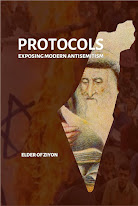
PROTOCOLS: Exposing Modern Antisemitism (February 2022)


Thursday, February 02, 2023

This is a Twitter thread from author and researcher Hussein Aboubakr Mansour that is a good follow-up to my earlier post on liberal Palestinians supporting terror.

__________________________________________

Underneath the positions of pro-Palestinian progressive Westerners lies a conglomerate of presuppositions and assumptions that are rarely openly discussed or mentioned. 

One of such major presuppositions is that Palestinian terrorism, the indiscriminate murderous violence 
targeting mostly defenseless Jewish civilians, is a core part of the Palestinian identity and a normative Palestinian behavior to be expected. As such, this behavior can not be blamed on Palestinian society or institutions but on Israel and Israeli action, which controls the structure of power from which the Palestinian identity emerged.

 In this position, highly intelligent people discover the most troubling aspect of the conflict but only to dismiss it. This form of humanistic bigotry against the Palestinians came to justify their worst inclination and disregard the lives of Israeli Jews, ending up being one of the most dehumanizing positions towards Israelis and Palestinians. 

This position is not new but has become a core intellectual habit of the international left since the canonization of the works of 
Frantz Fanon as a Bible of decolonization. According to Fanon, the murderous rampage of the colonized man against the colonizer is the quintessential act of self-liberation. The blaze of wrath and anger that ends in murder is nothing but the birth pains of freedom. In other words, the struggle, no matter how violent or extreme, is an existential condition and an ontological urgency. 

These ideas, which started in the circles of the French Left in the 1950s to justify Algerian acts of extreme violence against the French colony, became a solid part of the international left, taught in the most prestigious academic institutions to generations of leftist activists, journalists, professors, politicians, and others. These ideas, the epitome of dehumanization and pathological misanthropy, were not born yesterday and are parts of the major intellectual edifice of leftists' social and political thought.

The proliferation of such intellectual pathologies is what ultimately enables armies of American and European journalists, diplomats, aid workers, NGO officials, and others to totally accept the prevalence of violence, icons of death, and the valorization of cruelty in Palestinian culture, both popular and high, and in education. This leads to the interesting simultaneous recognition and dismissal of the most central problem of the Palestinian-Israeli conflict, the absolute and final negation of Zionism, by any means necessary, as the central ideological content of the Palestinian identity and its symbols. 

The final result is an international behemoth made of international institutional structures established and financed to purportedly solve the Palestinian-Israeli conflict while, in effect, ignoring its core issue. Palestinian media, religious, political, and educational institutions are left to daily indoctrinate members of the Palestinian society into believing that the meaning of their identity is existential victimhood which could be exited only through the total and complete destruction of Israel done by way of blood, death, and sacrifice. 

Anyone who dares to examine Palestinian education, media, literature, poetry, music, etc., would not be able to ignore the unsubtle presence of such violent ideas in Palestinian national symbolism and Palestinian self-image. This is ultimately the root cause of the total insolubility of the conflict. Until this conversation becomes a central component of any efforts seeking peace and stability, the problems of terror, violence, the loss of innocent Jewish lives, and the indoctrination of Palestinian youth will continue. 

I also would not be honest if I don't address the other side of the coin, the people with whom I stand on most issues, the pro-Israel camp. Many in that camp do see with clearer vision the problem with Palestinian identity and its content of terrorism. Yet, they refuse to make any distinction between the Palestinians as humans and the Palestinians as Palestinians. That is, they accept to see the Palestinians exactly the way Palestinian radicalism insists on seeing the Palestinians, walking landmines waiting to explode to totally erase Jewish existence. 

They accept the Palestinian self-dehumanization as the ontological truth of the Palestinians: final, exclusive, and irreversible, and not as humans who are trapped into a terrible story made up by generations of mad intellectuals and sadistic tyrants. This leaves nothing but a security problem against which Israel must remain strong. No will, no wish, no effort, and no thought are spent about the possibility of helping the Palestinians wake up from their self-imposed nightmare and discover a different way to be Palestinian. 

Just to reiterate, I'm not talking here of people who think, feel and talk only in leftist cliches. Those don't see or understand such complex problems anyways. I'm talking about the non-cliche ones who despite understanding the monumental weight of culture and identity refuse to deal with them seriously. 

__________________________________________

I would like to comment on the final three paragraphs, since people like me are the target.

Speaking for myself, I know that in the past I generalized Arabs altogether as permanently imprisoned by their hate for Israel and antisemitism, based on years of reading their own media and social media. The Abraham Accords was a sea change not only for the Middle East but in my perception of hope for the future as well. 

Right now, for the first time, one can see articles sympathetic to Jews in Arab media, especially Bahrain, the UAE and Morocco. Jews and Israelis can walk freely in those countries, much safer than they can walk in parts of Jerusalem. 

I take Palestinian incitement and support for terror very seriously. It is clearly a problem that is based on generations of hate and lies, on media and governments and curricula that simply do not allow freedom of thought or expression or any opinions that run counter to the official lines. Changing that has to be the top priority for any possibility of peace.

But as with the Abraham Accords countries, the change has to come from within.  There is nothing the West can do to change the Palestinian mindset. On the contrary, Palestinians are resentful when the EU or US insist that funds not be used to further support for terror. 

I hope that Mansour is right and the environment that supports the overwhelming Palestinian support for murdering Jews can be changed. But that requires a Palestinian leadership that does not exist and is not on the horizon.


Buy the EoZ book, PROTOCOLS: Exposing Modern Antisemitism  today at Amazon!

Or order from your favorite bookseller, using ISBN 9798985708424. 

Read all about it here!


AddToAny

Printfriendly

EoZTV Podcast

Podcast URL

Subscribe in podnovaSubscribe with FeedlyAdd to netvibes
addtomyyahoo4Subscribe with SubToMe

search eoz

comments

Speaking

translate

E-Book

For $18 donation


Sample Text

EoZ's Most Popular Posts in recent years

Search2

Hasbys!

Elder of Ziyon - حـكـيـم صـهـيـون


This blog may be a labor of love for me, but it takes a lot of effort, time and money. For 20 years and 40,000 articles I have been providing accurate, original news that would have remained unnoticed. I've written hundreds of scoops and sometimes my reporting ends up making a real difference. I appreciate any donations you can give to keep this blog going.

Donate!

Donate to fight for Israel!

Monthly subscription:
Payment options


One time donation:

Follow EoZ on Twitter!

Interesting Blogs

Blog Archive