
 Tuesday, May 05, 2026
 Elder of Ziyon
Ask most Americans what the Bill of Rights is and they will tell you it is a list of things the government must protect — free speech, due process, protection against unreasonable searches. Ask them what obligations the Constitution places on citizens and the list seems thin: paying taxes, jury duty, the draft when it existed. If there is a covenant, there must be obligations on both sides. So what are Americans supposed to do to hold up their end?
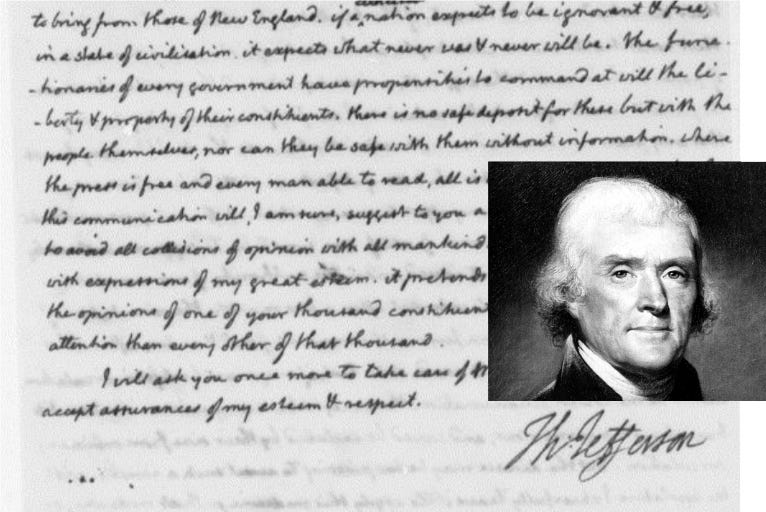
The Constitution does ask Americans for things, though not explicitly — the obligations are implied by the architecture rather than enumerated in the text. At the epistemic level, the Constitution presupposes a citizenry capable of self-governance, which is not a natural condition but one achieved by study and participation. Jefferson understood this clearly: “If a nation expects to be ignorant and free, in a state of civilization, it expects what never was and never will be.” The ignorance he was warning against was the civic ignorance of people who have inherited the covenant’s protections without understanding what the covenant requires of them in return.
Americans are expected to vote — but to do that meaningfully they must be informed enough to engage in the associational life that Tocqueville identified as the actual machinery of self-governance.
The Declaration and the Constitution assume that every person has dignity and must be treated as such, and that obligation falls on citizens as well as governments. “Endowed by the Creator” means the rights precede the state — which means the people must treat each other as bearers of those rights, not only demand that the government do so. That requires engaging in good faith with people who disagree, subjecting your own positions to genuine scrutiny, and treating the argument process as something that constrains you rather than something you are trying to win.
And at the deepest level sit constitutive obligations — the ones the covenant member owes not to any particular institution but to the framework itself: maintaining the conditions under which other citizens can fulfill their obligations, ensuring that the covenant’s promise of genuine membership is real for everyone who has accepted its terms, holding the covenant to its stated standards even when that is personally and politically costly.
Most of the current damage to American civic life is happening at the epistemic and constitutive levels — in the domains no law can reach, in the space between the legal floor and the ceiling of full covenant membership, where the law was never supposed to go and cannot repair what is breaking. We have forgotten what we owe.
There is a structural reason why the obligation side of citizenship has atrophied while the rights side has grown. Democratic politics has a built-in incentive asymmetry: demanding rights wins votes, demanding obligations loses them. The politician who promises to expand what citizens receive will reliably outperform the politician who reminds citizens what they owe. The incentive corrupts the political class’s communication before anyone consciously decides to be dishonest — rights-language is rewarded, obligation-language is punished. Over decades, the vocabulary of citizenship contracts to the language of entitlement, and the vocabulary of obligation quietly disappears.
There are exceptions worth naming. Kennedy’s 1961 Inaugural Address was striking not only for what he demanded but for his clarity that people should expect no concrete benefit in return: “Ask not what your country can do for you — ask what you can do for your country….With a good conscience our only sure reward, with history the final judge of our deeds, let us go forth to lead the land we love.” Roosevelt’s Fireside Chats tried to unite Americans to cooperate through both the Depression and a world war. Both understood that the covenant requires something from citizens that cannot be purchased or legislated. That understanding is largely absent from contemporary political leadership.
Civics education was supposed to resist this atrophy. At its best it was the formal mechanism by which each generation of native-born citizens was introduced to the covenant they had inherited — not just its protections but its demands, not just what it gave them but what it expected in return. It has all but disappeared due to a convergence of failures from opposite directions. Standardized testing squeezed it out by rewarding only what could be measured in math and English scores; civics value shows up in behavior years later, not in next semester’s results. The political left found the traditional civics narrative — America’s founding, its greatness, its heroes — uncomfortable and politically inconvenient, and rather than reform it to incorporate honest accounting of the covenant’s failures, delegitimized the narrative entirely. The political right found honest accounting of those failures threatening to its preferred story, and replaced civics with pageantry — celebration without examination, patriotism without obligation. Both destroyed civics from different directions; neither transmitted the covenant.
The result is a citizenry that relates to its government the way a consumer relates to a service provider. The government delivers, the citizen receives, and the only question worth asking is whether the delivery is satisfactory. Obligations feel like interruptions. Jury duty is resented. Voting is optional. Writing to a representative is something other people do. The covenant’s demands, which always depended on civic culture rather than legal compulsion for their transmission, have simply ceased to be transmitted.
A little reflection shows that obligations are not foreign to Americans — they simply operate closer to home. We are obligated to our families, to our friends, to our coworkers, to our local communities. We volunteer for charitable causes and neighborhood watches and emergency services and school PTOs. These are covenants operating at intimate scale: the unstated but very real agreement that if we expect to be helped when times get rough, we are also expected to help others when things are hard for them. Marriage is an explicit covenant. The neighborhood watch is an implicit one.
What this reveals is a set of concentric circles of obligation, outward from family to neighborhood to community — and the national covenant sits at the outermost ring, not qualitatively different from the others but more abstract, more demanding, and far easier to ignore.
Beyond the community sits the city or state covenant — the obligations that come with belonging to a specific place and its particular institutions. Further out sits the national covenant: the most abstract and the most easily deferred. These covenants differ in scale and specificity, not in kind. The obligations of family are highly specific, immediately legible, enforced by proximity and love and daily contact. The obligations of national covenant are abstract, enforced only by civic culture and the citizen’s own sense of what membership requires. This is why the national obligations are the most commonly neglected — they carry the least immediate consequence for the individual who ignores them while producing the greatest long-term damage to the covenant everyone depends on. If one person ignores the national covenant, there is no noticeable impact. When everyone shirks the responsibility, the national covenant can fail catastrophically.
Beneath all covenants, at the foundation rather than the outer ring, sits the dignity floor: what you owe persons prior to any covenant, the non-negotiable minimum that no covenant may breach. You do not need to be in a family covenant, a community covenant, or a national covenant to owe another person basic recognition of their inherent dignity. That obligation precedes every other; the covenants above it specify what more you owe within particular relationships without replacing or overriding the foundation.
Beneath the covenantal obligations — beneath the national, the civic, the communal — sits something the covenant cannot create and cannot replace: personal integrity. This is the capacity to be the same person in private that you present in public, to mean what you say when you say it in the presence of witnesses, to feel the weight of a commitment not because someone is watching but because you understand yourself to be someone who keeps commitments. The covenant presupposes this capacity. It cannot install it.
Washington understood the problem with uncomfortable clarity. Where, he asked in his Farewell Address, is the security for property, for reputation, for life, if the sense of religious obligation deserts the oaths that courts of justice depend on? He was asking what makes a person keep faith with a commitment when breaking it becomes convenient — and his answer was that religious obligation, the sense of a witness who cannot be deceived or evaded, was what reached that space. The problem is real. Washington was describing what happens when the person in front of you can calculate, coolly and correctly, that defection costs less than compliance.
No framework fully solves this. A person entirely without conscience will defect from a covenant as readily as they will lie under oath. The Quakers understood this better than Washington did: their refusal to swear oaths rested on the argument that a person of genuine integrity needs no special invocation, because their ordinary word is as binding as any sworn statement. The oath-to-God mechanism, on this view, is weaker than it appears — it creates a two-tier system of trustworthiness, implying that statements made without it are less reliable, rather than demanding that every statement carry the same weight.
What the covenant can do — what it does, at its best — is create the conditions under which integrity is more likely to develop and be maintained. The repeated public commitment; the community that witnesses and holds you to what you said; the constitutive act of entry that makes defection visible as self-contradiction rather than mere rule-breaking: these are not substitutes for integrity, but they are the environment in which integrity forms. This is why Washington’s concern, though genuine, pointed to a problem already present in covenantal structures millennia before the American founding. The Sinai covenant did not assume its members were already righteous. It assumed they were people in whom righteousness could be cultivated, given the right framework of obligation, community, and repeated public affirmation.
Integrity, then, is the unlegislatable prerequisite. It is not a covenant obligation in the sense of something you owe the framework from the outside; it is what makes you capable of having obligations at all. A citizenship built on rights and obligations, but populated by people who treat their commitments as costs to be minimized when no one is watching, is a citizenship that will collapse into the forms of the covenant without the substance — the correct words at the investiture, the ballot cast with no thought behind it, the hand over the heart during the anthem while calculating what can be extracted from the system before someone notices. Adams was right that the Constitution was made for a moral people. What he left implicit, and what Washington named, is that morality in this sense is not a policy position or a religious affiliation. It is the condition of meaning what you say.
Rights and obligations flow in opposite directions through this structure, and the difference matters for understanding what the covenant asks of citizens at each level.
Rights flow downward. The Declaration establishes the moral premises at the highest level of abstraction — all men are created equal, endowed with unalienable rights, government exists to secure these rights and derives its just powers from the consent of the governed. The Bill of Rights translates those premises into specific, enforceable, constitutive commitments at the federal level. State law then builds specific rules and implementations above that federal floor, and the individual receives, at the end of this chain, specific protections that constrain what any level of government may do to them. The further down the chain you go, the more specific and legally enforceable the protection becomes — the federal level is moral and principled, the state and local level legal and specific.
Obligations flow outward. The individual bears the most concrete and immediately legible obligations at the family level, where the covenant is intimate and the consequences of breach are felt immediately by people whose faces you know. Moving outward through community, city, state, and nation, the obligations become progressively more abstract, harder to fulfill through daily action, and easier to defer. The national obligations — accepting electoral outcomes, supporting the institutions that constrain all parties including your own, maintaining the framework even when it produces results you oppose — are the hardest to hold because no one is there to notice when you drop them, and the ones that matter most for whether the covenant survives.
Kennedy understood this asymmetry and named it directly. His Inaugural Address asked Americans to act without expectation of personal reward — not because sacrifice is intrinsically noble but because the national covenant’s obligations are too abstract to carry their own enforcement. Only citizens who understand what they owe and choose to honor it anyway can sustain what no law can compel. No president since has stated this as plainly.
At this moment, covenantal civic behavior — the daily, unglamorous practice of honoring obligations that no one can compel — is degrading, not disastrously and not irreversibly, but measurably. Each generation that fails to transmit the covenant’s obligations makes the following generation’s transmission harder. Each breach that goes unaddressed normalizes the next.
The rest of this essay is available to subscribers on Substack and will be seen in my forthcoming book.

|
"He's an Anti-Zionist Too!" cartoon book (December 2024) PROTOCOLS: Exposing Modern Antisemitism (February 2022) |
 |
 Buy
Buy


