
Antisemitism, etymologically and by definition, means being against Jews. Everyone agrees on that much. The problem is that before you can define antisemitism, you need to define what Jews are.
This seems obvious once you think about it. Yet none of the major definitions of antisemitism tackle this.
This is one reason every major definition is perpetually contested. The endless arguments about how to define antisemitism are, at bottom, arguments about how to define Jews — conducted by proxy, with neither side naming what they are actually arguing about.
The Jerusalem Declaration on Antisemitism, written in explicit response to IHRA, and structured to exclude most forms of anti-Zionism, has no independent, positive definition of Jewish identity. It defines antisemitism as hostility toward Jews as Jews — which simply assumes everyone already knows what Jews are. When the JDA then adjudicates which forms of anti-Zionism are or are not antisemitic, it is making implicit decisions about whether Jewish nationhood is a core dimension of Jewish identity or a separable political position. It never states that premise openly. It builds the conclusion into the framework and presents the result as analysis. But their language of “Jews as Jews” implies that Jews are not a people, not a nation, not a collective at all - just a faith and maybe a shared ancestry with little else in common. The definition constructs an implicit and fuzzy definition of Jews, quietly, by deciding which attacks on Jewish identity count.
The same problem runs through every major framework, at varying levels of severity.
The widely adopted IHRA working definition of antisemitism is better than most. It gets the Israel-related examples right but cannot derive them from first principles, because it never states the premise that makes them follow. Open the text and the hedging is immediate. Antisemitism is defined as “a certain perception of Jews, which may be expressed as hatred” — a certain perception, unspecified; may be expressed, not necessarily. The examples “may serve as illustrations.” Manifestations “might include the targeting of the state of Israel.” And the examples themselves apply only when they “could, taking into account the overall context,” constitute antisemitism. That’s four layers of qualification in the definition and its introduction alone. The drafters were not careless. The hedging is structurally required because without a stated account of what Jews are, IHRA cannot say confidently what attacks on Jews look like. Every “may” and “might” and “taking into account the overall context” is a door left open for someone operating from a narrower definition of Jews. Denying Jewish self-determination — well, in context, that might not be antisemitic. IHRA did not accidentally leave that door open. It had no foundation from which to close it.
The Nexus Document acknowledges Jewish nationhood but treats it as subject to moral constraints that other nationalisms are not. That asymmetry is load-bearing and also unstated — which means it also cannot be defended, only assumed.
Because all three fail to define what they are claiming to defend, they must fall back on examples as guidelines. IHRA has eleven. The JDA has fifteen. The Nexus Document runs to several thousand words. None of it resolves the ambiguity, because examples cannot substitute for a definition — they can only multiply the surface area available for dispute. Every new case becomes an argument about whether it fits a specific example rather than an argument from first principles. The debates are endless by structural necessity, not by accident.
In reality, Jews are simultaneously an individual identity, a people, a religion, an ethnic group, and a nation — with Israel as the contemporary political expression of that last dimension. These are not alternative descriptions of the same thing. They are distinct, all of them real, all of them historically continuous, and all of them targets of anti-Jewish hostility at various points in history and in the present. Indeed, each new type of antisemitism carefully distinguishes itself from previous ones because it defines Jews differently - Christian antisemites attacking the Jewish religion, racial antisemites defining Jews as a race and claiming to be more scientific, Protocols pretending that they are only against shadowy Jewish manipulators but not the entire population, and the current versions denying Jewish peoplehood and therefore their right to self determination. After all, religions do not require self determination - a people does.
Jews are a people, with a religion, a civilization, an ethnicity, and a have a historical attachment to a specific land that predates the modern state by three millennia. Denial of any of those aspects is itself antisemitic. Arabs argue that Jews are European because that protects their claim to the land of Israel; white supremacists insist Jews are Middle Eastern because their racial theories must categorize Jews as inferior to their Aryan ideal. No single theory of antisemitism can work without recognizing this wide divergence of hate.
Some will object that identifying Israel with the Jewish nation conflates two distinct things — that am Yisrael, the Jewish people, is not identical to medinat Yisrael, the Israeli state. The theological and demographic distinction is real, but in this case it is a distinction without a practical difference. Israel is the only state in the world that defines itself as Jewish; it is home to nearly half the world’s Jews already; 80% of its population is Jewish and a constitutional Law of Return that treats Jewish immigration as a national right rather than a bureaucratic privilege. Israel is the most visible manifestation of Jewish peoplehood, and more often than not those who are anti-Zionist also deny Jewish peoplehood and attachment to the land. If the Jews are a people they have the right to self determination in their ancestral lands; those who want to deny the latter inevitably end up denying the former.
A few years ago, I created a definition of antisemitism that addresses this gap.
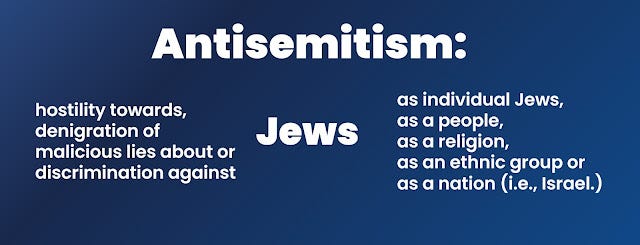
Antisemitism is hostility toward, denigration of, malicious lies about or discrimination against Jews — as individuals, as a people, as a religious community, as an ethnic group, or as a nation.
This formulation does not pick one dimension of Jewish identity and protect only that. It enumerates all of them, which means it cannot be gamed by reducing Jews to any single one. Indeed, denying the existence of any of these dimensions of Jewish people is antisemitic itself., which means that the anti-IHRA definitions that deny Jewish peoplehood are not only bad definitions but part of the problem. They don’t want to say explicitly that they believe Jewish peoplehood is a fiction, or that three thousand years of continuous attachment to a land does not constitute an indigenous relationship, or that the only legitimate Jews are those who have stripped their identity down to private religious observance. Yet those are the actual claims required to make the narrow definitions work. Stated plainly, they are recognizable as anti-Jewish positions.
In fact, because my definition defines Jews as well as antisemitism, it is exhaustive. Any act or language that fails my definition is not antisemitism. There is no need for "context” or “mays” or “mights.”
The arguments about antisemitism definitions are arguments about what Jews are. Define Jews first, and the arguments have to be conducted honestly.
|
Reclaiming the Covenant on America's 250th (May 2026) "He's an Anti-Zionist Too!" cartoon book (December 2024) PROTOCOLS: Exposing Modern Antisemitism (February 2022) |
 |
 Buy
Buy