
(Entire series here.)
Chapter 2 gave you tools for evaluating who is telling you something. This chapter asks a prior question about what they are telling you: can it, in principle, be proven wrong?
This is falsifiability.
The question is simple, but the implications are far reaching. A surprising number of claims pretend to be objective but in fact are composed in such a way that any potential evidence that can prove it wrong would be discarded or twisted to be further proof that it is right.
A claim that cannot be proven wrong — one constructed so that no conceivable evidence could count against it — has removed itself from the domain of things that evidence can evaluate. It cannot be tested, refuted, or confirmed in any meaningful sense. It is not connected to reality. Engaging with such a claim as if it were a factual assertion is a category error, because the claim is a closed system presenting itself as an open one. The falsifiability question is the tool for identifying closed systems, and it must be one of the first things to ask when evaluating a new theory or claim.
Karl Popper formalized this criterion in the twentieth century, and it applies to everyday life as well as to science. A claim says something about the world only if some possible state of the world could show it to be false.
Two Ways of Testing a Belief
To understand falsifiability, we must talk about truth.There are a few theories of truth, but the most prevalent ones are the correspondence theory and the coherence theory.
Correspondence reasoning tests a belief against external reality. The claim holds if it matches something in the world that exists independently of the framework holding it. Evidence comes from outside — from observation, from measurement, from outcomes that occur regardless of what the framework predicts. When the evidence contradicts the claim, the claim is revised. The direction of accountability runs from reality to belief.
Coherence reasoning tests a belief against internal consistency. The claim holds if it fits with everything else the framework already contains. Evidence is evaluated by whether it coheres with the existing picture. When incoming information contradicts the framework, the information gets reinterpreted, contextualized, or set aside. The direction of accountability runs from belief to evidence — the framework judges the evidence, not the other way around.
Both have legitimate uses. A mathematician testing a proof against the axioms of the system is doing coherence reasoning properly. A scientist testing a hypothesis against experimental data is doing correspondence reasoning properly. The problem we are addressing is what happens when coherence reasoning operates while presenting itself as correspondence reasoning — when a framework is testing its claims against itself while appearing to test them against the world.
This is harder to detect than outright fabrication, because the framework looks like it is engaging with evidence. It might cite studies and reference data. What it does not do is allow any of that material to actually threaten the conclusion. The studies that confirm the framework are cited; the studies that complicate it are explained away or not mentioned. The data consistent with the framework is highlighted; the data inconsistent with it is contextualized into irrelevance. The objections are answered — but the answers are drawn from within the framework, which means the framework is answering itself.
Falsifiability is the test that separates correspondence reasoning from coherence reasoning in practice. A claim that can specify what evidence would prove it wrong is, at minimum, maintaining contact with the possibility that it could be wrong — which means it is accountable to something outside itself. A claim that cannot specify what evidence would prove it wrong has placed itself beyond accountability entirely, regardless of how confidently it presents itself as a factual assertion about the world. The conspiracy theory is the limit case of this: a framework so thoroughly coherence-driven that every piece of external evidence gets absorbed and reinterpreted rather than registered. But the conspiracy theory is only the most visible instance of a structure that appears across ideology, institutions, and expertise whenever a framework becomes more important to its holders than the reality it was built to describe.
The Structure That Eats Evidence
Conspiracy theories are the most recognizable unfalsifiable claims, which makes them useful for naming the structure before locating it in less obvious places.
The moon landing denial framework works as follows. The evidence for the Apollo landings is extensive: the Soviet Union tracked the missions with independent systems and never disputed their success despite every political incentive to do so, lunar samples have been studied by scientists worldwide for decades and match nothing found on Earth, and hundreds of thousands of workers contributed to a program whose basic operational reality would have required an implausible conspiracy to fake. A person evaluating this claim by asking whether the evidence matches the assertion would find the landing well-supported and the faking hypothesis implausible.
The conspiracy framework handles this evidence without difficulty. The Soviet silence is explained by a secret superpower agreement. The lunar samples were fabricated or the scientists examining them are part of the network. The hundreds of thousands of workers were either complicit or compartmentalized. Every piece of evidence against the theory becomes, inside the framework, evidence for it — proof the conspiracy is larger and more sophisticated than previously imagined. Ask a committed moon landing denier what evidence would convince them the landings were real, and you will get either silence, an infinite regress of demands that will be reinterpreted on arrival, or the explicit admission that no evidence could change their mind. That last answer is at least honest about the framework’s structure.
The conspiracy theory is easy to dismiss because the subject matter is exotic. The same structure operating inside more respectable frameworks is harder to see and considerably more consequential.
White Fragility and the Unfalsifiable Self
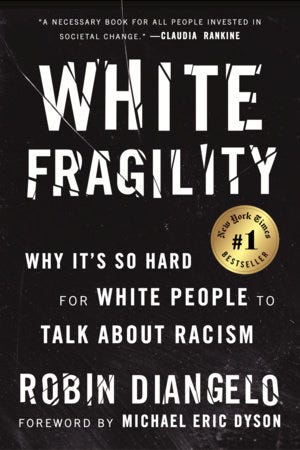
In 2018, Robin DiAngelo published White Fragility, which became one of the most widely read and widely adopted frameworks in American corporate and educational institutions. The book’s central claim is that white people in a racist society inevitably internalize racism, that this internalized racism operates below conscious awareness, and that white people’s resistance to being told they are racist is itself a manifestation of their racism — the “fragility” of the title.
This cannot be falsified. A white person who acknowledges their racism confirms the framework. A white person who denies their racism demonstrates the fragility the framework predicted, which also confirms the framework. A white person who engages calmly with the accusation is exhibiting the “weaponized niceness” the framework has also anticipated. A white person who becomes upset is exhibiting the emotional fragility the framework names. A Black person who insists that their white friend is not a racist is not aware of how deep and foundational their friend’s racism really is. Every possible response has been pre-categorized as confirmation.
Ibram X. Kendi’s How to Be an Antiracist presents a different and more precisely located unfalsifiability problem. His central claim is stated without qualification: “There is no such thing as a nonracist or race-neutral policy. Every policy in every institution in every community in every nation is producing or sustaining either racial inequity or equity between racial groups.”
The falsifiability failure is in that foundational premise rather than in Kendi’s diagnosis of individuals. Consider a company policy requiring employees to arrive at work on time. Under Kendi’s framework, this policy is either producing racial inequity or racial equity — there is no third category available. If punctuality requirements produce differential disciplinary outcomes along racial lines in some workplace data, the framework classifies the policy as racist regardless of intent. The possibility that the policy is a straightforward operational requirement with no racial valence whatsoever does not exist within the framework, because Kendi has defined race-neutrality out of existence by assertion. The same applies to a cybersecurity policy prohibiting employees from connecting external USB drives to company computers: whatever its racial outcome data shows, it must be either racist or antiracist, because the neutral category has been declared empty before any examination. And you cannot say that Kendi cannot be referring to technical policies, he says explicitly, “By policy, I mean written and unwritten laws, rules, procedures, processes, regulations, and guidelines that govern people.” A policy that says that auditors must annually verify a company’s financial system is either racist or anti-racist, according to Kendi.
This is a falsifiability failure at the foundational level. The claim that every policy has a racial valence is presented as a self-evident truth rather than as an empirical finding — which is precisely what it would need to be to avoid being an unfalsifiable premise. A genuine empirical claim would specify what a race-neutral policy would look like and what evidence would establish that a given policy meets that description. Kendi’s framework specifies neither, because the neutral category cannot exist within it. The premise is doing the work that evidence is supposed to do, and no evidence could dislodge it.
The underlying empirical observation both frameworks rest on — that racial disparities exist and that structural factors contribute to them — has genuine evidentiary support and deserves serious engagement. The unfalsifiability problem is in the epistemological architecture, not necessarily in the underlying observation. A correct conclusion can be held in an unfalsifiable way, and when it is, the person holding it has no reliable method for distinguishing cases where the framework gets it right from cases where it gets it wrong, because the framework has been constructed to produce no cases where it gets it wrong.
The practical question DiAngelo’s framework cannot answer: what evidence would demonstrate that a specific white person is not racist? The practical question Kendi’s framework cannot answer: what would a race-neutral policy look like, and how would you recognize one? If neither question has an answer within the framework, the framework has left the domain of empirical claims.
Both DiAngelo and Kendi are also making implicit statistical claims that do not survive elementary scrutiny. Any claim about a population that cannot be fully enumerated requires sampling. Sampling produces estimates, not certainties. Estimates have confidence intervals. A reputable poll reports not just a percentage but a margin of error and a confidence level — “47% support X, plus or minus 3 points, at 95% confidence” — because those numbers tell the reader how much weight to place on the finding.
DiAngelo’s claim that every white person has internalized racism is a universal generalization about the psychology of hundreds of millions of people. Kendi’s claim that every policy in every institution in every community in every nation produces either racial equity or inequity is a universal generalization across an essentially infinite domain. Both are implicitly asserting a finding of 100% accuracy with 100% confidence — a standard no reputable researcher would claim about almost any empirical question, because no sampling methodology reaches every member of an unbounded population. The methodology section of a paper supporting either claim could not be written, because there is no methodology. The number was not measured. It was stipulated.
Asking a claimant to specify their confidence level and describe their sampling methodology is not an attack on their politics. It is the most basic question any empirical claim must answer. The inability to answer reveals that the conclusion was never derived from evidence — which means it cannot be evaluated as an empirical claim at all, only accepted or rejected as an article of faith.
When Labels Detach from Definitions
A recurring weapon in public argument operates through language itself. Rather than making an empirical claim that evidence could evaluate, the argument redefines a term so that the desired conclusion is built into the definition. Once the redefinition is accepted, the conclusion follows automatically — not because evidence supports it, but because the definition made it inevitable. The argument has the appearance of reasoning and the structure of a tautology.
There are many academic articles and books that redefine racism as “power-plus-prejudice.” The standard definition — prejudice or discrimination based on race — applies to any person of any background who holds such attitudes or acts on them. The redefinition, now standard in many sociology departments and diversity training programs, adds an institutional power requirement: racism is prejudice plus power, which means only members of groups with institutional power can be racist. Under this definition, a person from a marginalized group who harbors genuine hatred of another group and acts on it is, by definition, not racist — regardless of their attitudes, their behavior, or the harm they cause. The conclusion that marginalized groups cannot be racist is not a finding; it is a consequence of the definition. No evidence about actual attitudes or behavior can touch it, because the category has been sealed before any evidence is examined.
Notice that the original observation motivating the redefinition is not absurd. Power is genuinely a factor in how racism operates institutionally, and a sociology of racism that ignores structural power misses something real. The redefinition earns its initial plausibility from that legitimate observation. What it then does is use that plausibility to smuggle in a universal categorical claim — that power is not merely a factor but the only factor, that its absence makes prejudice not-racism by definition — which the original observation does not support and which closes off the category entirely from one direction.
This pattern repeats across the vocabulary of contemporary social argument. “Harmful speech is violence” requires redefining violence to include psychological discomfort produced by words. Once accepted, the conclusion — that speech causing discomfort should be treated as physical violence and responded to accordingly — follows automatically. The argument is not about whether speech can cause harm, which is uncontroversial. It is about whether the category of violence should be expanded to include it, which is a definitional choice presented as a discovered fact. The person who disputes the conclusion appears to be denying that speech causes harm, which is not what they are disputing. The redefinition has shifted the terrain of the argument without announcing that it has done so.
The application of established legal and historical terms to the Israel-Palestinian conflict follows the same mechanism, but with an additional layer. Genocide, as defined in the 1948 UN Convention, requires the intent to destroy a national, ethnic, racial, or religious group in whole or in part — a specific mental element that distinguishes it from other mass atrocities. Apartheid, as a legal and historical category, refers to a specific system of institutionalized racial segregation enforced by law. Colonialism, as originally theorized, describes a specific relationship between a colonial metropole and a settler population transplanted to displace an indigenous one.
Arab citizens of Israel vote, hold seats in the Knesset, serve on the Supreme Court, and are represented in the medical and legal professions. Israeli law does not classify citizens by race or impose legal restrictions based on racial classification. These facts are available, uncontested, and directly relevant to whether the apartheid definition applies in its original sense. The people applying these labels to Israel are generally aware of these facts. Their response is that the definitions have evolved — that apartheid now encompasses any system producing differential outcomes along ethnic lines, that genocide no longer requires demonstrated intent to destroy, that colonialism applies even when the “settler” group is the original indigenous population.
Each of those responses may contain a legitimate argument worth engaging in a different context. What they collectively accomplish is the removal of any specified conditions under which the labels would not apply. If apartheid means any system producing differential outcomes between groups, then the question of whether Israel is an apartheid state has no falsifying condition, because differential outcomes between groups exist in every society on earth (although note that the expanded definition is never applied in any other context.) If genocide no longer requires intent, the category expands to include virtually any military operation with a large number of casualties. If colonialism is only from European nations, the term loses the structural analysis that gave it explanatory power and becomes a label for any migration the framework disfavors. The labels have been stretched until they can fit anything, which means they no longer say anything specific.
The diagnostic question for definitional capture is different from the falsifiability question, though the two are related. Don’t ask “what evidence would prove this wrong” but “what work is this definition doing, and who does it serve?” A definition that is genuinely descriptive — that carves reality at its joints — includes some things and excludes others based on properties of the things being described. A definition constructed to ensure that a predetermined set of things falls inside it, and a predetermined set falls outside, is not describing reality. It is organizing it for a purpose, and the purpose is visible in what the definition systematically includes and what it systematically excludes.
The connection to the previous section runs in both directions. Definitional capture often produces universal claims as a corollary — once racism is defined as requiring institutional power, it becomes universally true, 100% with no exceptions, that marginalized groups cannot be racist. That 100% did not come from measuring anyone’s attitudes. It came from the definition. The unfalsifiable universal claim and the captured definition are frequently the same argument at different levels of abstraction. Recognizing either one exposes both.
The Unfalsifiable Mind
There is a category of unfalsifiable claim that deserves its own examination because it has a surface plausibility the other types lack: the assertion of intent.
We cannot read minds. This genuine epistemic limitation gives intent claims a built-in defense — demanding proof of what someone intended feels naive, because people and institutions routinely conceal their real purposes. A claim about intent might therefore seem to occupy legitimate uncertain territory rather than the unfalsifiable territory this chapter has been mapping.
A legitimate uncertainty about intent acknowledges that behavior is partial and imperfect evidence, that the question remains open, and that new evidence — documents, testimony, patterns of action over time — could move the assessment in either direction. The claim is difficult but not closed.
An unfalsifiable intent claim does something different. It specifies in advance how all possible behaviors will be categorized, which means no behavior can count as disconfirmation. Behavior consistent with the alleged intent confirms it. Behavior inconsistent with the alleged intent gets reclassified as serving the intent through concealment — strategic restraint, public relations, or tactical calculation. The framework has not merely acknowledged that behavior is an imperfect guide to intent. It has defined behavioral evidence as systematically unreliable in exactly the cases where it would disconfirm the claim, while remaining reliable in the cases where it confirms it. At that point the claim has immunized itself against behavioral disconfirmation entirely.
The claim that Israel intends to destroy Al-Aqsa Mosque illustrates the structure clearly because the timeline is so long and the capability so thoroughly documented. The claim began in the 1920s and has remained an article of faith among many Palestinian Arabs. Israel has controlled the Temple Mount since 1967, which means there is nothing preventing it from accomplishing what every Arab is certain is its biggest desire. The assertion that Palestinian steadfastness alone has prevented destruction across nearly six decades requires accounting for a continuous series of Israeli governments spanning the full political spectrum — governments that faced no particular domestic political cost for acting differently, governments with vastly different ideological orientations, governments that took actions far more controversial internationally than this would have been — all restrained by the same external mechanism. The simpler explanation, that Israel has not destroyed Al-Aqsa because it has no intention of doing so, is not available within the framework. Restraint has been preemptively classified as tactical, which means the half century absence of the predicted action cannot register as evidence against the predicted intent.
The genocide intent accusation directed at Israel operates through the same mechanism. Warnings issued to civilians before strikes are classified as public relations. Humanitarian corridors are classified as strategic calculation. The continued existence of a substantial Palestinian population after extended military operations is not registered as evidence against genocidal intent — it is explained as incomplete execution, or international pressure, or irrelevant to the underlying purpose. No action Israel could take would count as evidence against the intent claim, because the framework has specified in advance that all actions will be categorized as either expressing or concealing the intent. The claim is about a mental state that behavior cannot reach.
The pattern appears beyond the Israel context. The “dog whistle” framework in political analysis asserts that certain language communicates racist intent to a target audience through coded meaning, with the stated meaning serving as cover. This is sometimes correct and documentable — there are historical cases where coded language and its intended meaning are established by other evidence. The framework becomes unfalsifiable when any denial of the intended meaning is classified as further evidence of the concealment — when the speaker’s own account of their meaning is preemptively disqualified, and when no linguistic or behavioral evidence could establish that the stated meaning was the actual one. The claim has placed the alleged intent beyond the reach of the person alleged to hold it.
“They were never serious about peace” is another common version, applied to negotiating parties across many conflicts. Every concession made at the table is classified as tactical, forced by circumstances, or insufficient to demonstrate genuine intent. Every rejection is classified as revealing the true purpose. The framework assigns roles before examining the record, which means the record cannot revise the assignment.
The tell, in all of these cases, is the preemptive explanation. When a framework has specified in advance — before examining any particular action — how that action will be categorized, the framework is assigning roles rather than reading evidence. The question that exposes it: what behavior would demonstrate that the alleged intent is absent? If the framework’s defenders cannot answer that question, or if every proposed answer gets absorbed as a further manifestation of the concealment, the claim has left the domain of things that evidence can evaluate. The allegation of intent has become a premise rather than a conclusion, and the behaviors cited in its support are illustrations rather than evidence.
Identity as Epistemology: The Trump Case
Political identity produces a particularly clear version of the unfalsifiability problem because it is recent, extensively documented, and available to observation across the ideological spectrum.
A significant portion of the American population has organized its political identity around opposition to Donald Trump in a way that makes the evaluation of specific policies or actions secondary to the identity itself. The evidence for this is specific: several policies continued or adopted by the Biden administration that had been loudly opposed under Trump — drone strikes, border enforcement mechanisms, certain trade restrictions, recognizing Jerusalem as Israel’s capital — received dramatically less criticism from the same quarters, with the change in administration functioning as a sufficient explanation. The policy had not changed; the assessment had, because the assessment was tracking the source rather than the content.
If Trump does something his opponents would normally support, it gets explained as an exception, a trap, inadequate, or suspicious. If he does something his opponents would normally oppose, it confirms the framework. The framework produces only one verdict regardless of input, which means it is not evaluating Trump’s actions. It is expressing an identity.
The pro-Trump version of the same structure is equally observable. Policies and behaviors that would have produced fierce criticism if undertaken by a Democratic president — significant expansions of executive power, large increases in federal spending, departures from previous Republican orthodoxy on trade — get absorbed by the framework as either necessary, mischaracterized by a hostile press, or irrelevant compared to the larger stakes. The framework again produces only one verdict regardless of input.
The Trump case is useful specifically because it is so recent and so well-documented that readers can examine their own responses to it. The falsifiability question cuts through the identity: what would Trump have to do for you to revise your current assessment of him significantly upward, or significantly downward? If no answer comes to mind, the assessment has become a premise rather than a conclusion, and the reasoning that appears to support it is post-hoc advocacy rather than evaluation.
The Social Sciences and Performed Precision
The hardest version of the unfalsifiability problem for educated readers is the one wearing the most convincing scientific clothing.
Science earns its authority through specific procedures: controlled experimentation, peer review, replication, falsification testing, publication of null results. When those procedures are applied with integrity over time, the consensus they produce is genuine evidence and deserves to be treated as such. The authority is procedural, not merely institutional — it comes from what was done, not from who did it.
The social sciences occupy complicated territory. At their best they apply genuine scientific methodology to questions about human behavior and society, producing findings that are replicable, falsifiable, and regularly tested against disconfirming evidence. At their worst they use the framing and vocabulary of science — quantitative methods, academic publication, professional credentialing, copious references to other papers — to generate conclusions that have not been subjected to the procedures that make scientific consensus meaningful.
The distinction the reader needs is between a consensus built through genuine engagement with difficult evidence and a consensus maintained by treating heterodox researchers as not worth engaging, by making it professionally costly to raise specific objections, or by citing the breadth of agreement rather than the strength of the underlying evidence. The former is strong; the latter substitutes social enforcement for epistemological procedure.
Implicit bias research provides a clear recent example. The Implicit Association Test, developed in the 1990s, measures the speed of mental associations between concepts and became the empirical foundation for a substantial body of diversity training and policy intervention. The test’s architects and advocates claimed it measured implicit racial bias and that high scores predicted discriminatory behavior. Subsequent research found that the test’s scores show poor test-retest reliability — the same person taking the test twice gets meaningfully different results — and that the correlation between test scores and actual discriminatory behavior is weak and inconsistently replicated. The research consensus that had built up around the IAT was constructed substantially before those replication problems were identified, and the policy programs built on it continued long after the replication problems became known.
This is a falsifiability failure of a specific kind: the original claims were stated in ways that made them testable, they were tested, and the tests produced results that should have substantially revised the claims. The revision did not occur at the speed the evidence warranted because the claims had become institutionally entrenched — cited in training programs, embedded in HR policy, associated with careers and organizations. The social structure of the field preserved the consensus past its evidentiary expiration date.
The reader’s practical question, applied to social science claims: what procedures produced this consensus, and what has happened when those procedures were applied to disconfirming evidence? A consensus that has been tested against serious disconfirmation and survived is very different from one that has been insulated from it.
How an Unfalsifiable Framework Gets Broken
The recovered memory therapy movement of the 1980s and 1990s is the most thoroughly documented case of an unfalsifiable clinical framework operating at scale — and then collapsing. Examining how it collapsed is as instructive as examining how it worked, because the method that broke it is available as a general tool.
The framework rested on two claims. First, that traumatic memories can be repressed — buried below conscious recall by the mind as a protective mechanism. Second, that specific therapeutic techniques, including hypnosis, guided imagery, and dream interpretation, could recover those buried memories reliably. The unfalsifiability operated through the first claim: if absence of memory is itself evidence of repression, no patient’s report of not remembering can count as disconfirmation of abuse. Both the presence and absence of memory confirmed the framework.
Resistance completed the closure. When patients expressed doubt about the memories emerging in therapy, or resisted the therapist’s interpretations, that resistance was classified as further evidence of trauma — the mind protecting itself from unbearable material. Acceptance confirmed the framework. Resistance confirmed the framework. The patient had no move available that counted as disconfirmation.
The framework had also inverted the normal hierarchy of evidence. When children were said to have recovered memories in therapy of having been sexually abused by their parents, and the parents denied it, the recovered memory was treated as more reliable than the parent’s own recollection of events in their own home. The framework had pre-explained the denial: it was exactly what an abuser would say. The child’s recovered memory was pre-validated: it was what a trauma survivor produces when the repression finally breaks. The person with the most direct knowledge of whether the events had occurred had been epistemologically disqualified before they opened their mouth. This produced wrongful prosecutions, destroyed families, and patients who spent years in inpatient psychiatric wards being treated for abuse that had never happened.
The framework was not broken from inside. Nobody found the disconfirming evidence the framework had ruled out, because by design there was none to find. It was broken by a researcher who stepped outside the framework entirely and asked a different question.
Elizabeth Loftus did not try to prove that specific patients had not been abused. That was the question the framework controlled, and attacking it on those terms would have produced exactly the absorption the framework was designed for — more evidence of denial, more evidence of the defense mechanisms protecting the repressed material. Instead she asked whether the therapeutic process itself was a reliable instrument for distinguishing real memories from generated ones. That was a question the framework had never addressed, because the framework assumed its own procedures were valid. It was falsifiable. And it was answerable.
Her controlled experiments demonstrated that entirely false memories of childhood events could be implanted in normal subjects through suggestive techniques — getting lost in a shopping mall, spilling punch at a wedding, being hospitalized. Subjects remembered these events in vivid and emotionally convincing detail. The memories felt real. They had not occurred. The techniques being used in recovered memory therapy were at least as effective at generating false memories as at recovering true ones, and subjects could not distinguish between them.
This destroyed the framework not by finding disconfirming evidence inside it but by exposing that the process generating its confirmations was unreliable. The framework had immunized itself against patient denial. It had not immunized itself against the question of whether its evidence-production mechanism was trustworthy. Once that question was answered, the framework’s apparent confirmations dissolved rather than being refuted — the evidence base didn’t flip, it ceased to be evidence.
This illustrates a general method: when a framework has closed itself against disconfirmation from inside, ask what the framework’s apparent confirmations actually depend on, and whether that mechanism is reliable. The question is not “what would refute this conclusion” — the framework has already handled that. The question is “what would have to be true for this framework’s evidence to be genuine evidence, and is that condition met?” That question comes from outside the framework’s own terms, which is why the framework has no prepared answer for it.
This is a move we will develop further. A framework controls what question you think you are answering. Loftus changed the question. The recovered memory framework asked: did this patient repress memories of abuse? Loftus asked: can this process tell the difference between a real memory and a generated one? Those are not the same question, and only one of them was answerable.
What Would Change Your Mind?
Before engaging seriously with any claim, ask what evidence would falsify it. Ask it of the claim’s defenders. Ask it of yourself.
A defender who can answer clearly — “if X were shown to be true, I would conclude this claim is false” — is operating in the same epistemological territory you are, and productive disagreement is possible even if you assess the current evidence differently. A defender who responds by explaining how any proposed disconfirmation would be reinterpreted within the framework has told you that the conversation about evidence is over. What remains is a conversation about the framework itself, which requires different tools than the ones designed for evaluating claims.
Ask it of your own conclusions with equal rigor. What would have to be true for you to revise significantly the positions you currently hold with the most confidence? If the confident conclusions have no answer to that question, they have been converted from conclusions into premises — and the reasoning that appears to support them is functioning as advocacy rather than inquiry. That conversion can happen in any direction, to any person, on any subject. Recognizing it in yourself is harder than recognizing it in others, and more important. We’ll discuss this in future chapters.
|
Reclaiming the Covenant on America's 250th (May 2026) "He's an Anti-Zionist Too!" cartoon book (December 2024) PROTOCOLS: Exposing Modern Antisemitism (February 2022) |
 |
 Buy
Buy