
The Jewish Witness
Part 3 of my series on America at 250, Reclaiming the Covenant
Every argument has a tell.
In Jewish legal tradition, machloket l’shem shamayim — argument for the sake of heaven — describes a dispute conducted in genuine pursuit of truth, where the other side is still recognized as a legitimate participant in a shared enterprise. Its polar opposite is sinat chinam: baseless hatred, the condition in which the opponent is no longer someone you are arguing with but someone whose presence is itself the offense. The Talmud distinguishes these not by the content of the disagreement but by what each side does with the other’s existence. Hillel and Shammai disagreed about nearly everything for decades; their schools preserved each other’s opinions and their children intermarried. That is machloket l’shem shamayim. The factionalism that the rabbis blamed for the Second Temple’s destruction — groups so consumed by contempt for each other that the legal architecture for covenantal repair became unusable — is sinat chinam. The disagreement in both cases was real. What differed was whether the parties retained enough basic regard for each other to remain in the same covenant.
A covenantal society needs a way to know which condition it is in, because the two look similar from the inside — passionate disagreement always feels righteous to those conducting it — and the consequences of misreading them are severe. Part 2 established that the covenant’s renewal mechanism requires, as its operating condition, the willingness to grant your opponent the benefit of the doubt. But how do you know when that condition is being met and when it has already failed? How do you detect sinat chinam before it has progressed far enough to make the repair mechanism unavailable?
There is a diagnostic. It is not a survey or a political index. It is a pattern so consistent across three thousand years of history that it functions less like a coincidence and more like a structural law: the societies that are losing the basic regard between their members — that are converting policy disagreement into existential enmity, that are beginning to treat some of their members as outside the covenant’s protection — often show the same symptom first. They turn on their Jews.
The Jews are almost always the first target because they are the perennial test case for the covenant’s membership principle — a group identifiable as separate, whose full membership was most recently contested, most explicitly established by legal or founding act, and therefore most available to be re-contested when the covenant’s universalism begins to erode. A society willing to strip one group of its inherent dignity has already decided that dignity is conditional — available to be stripped from any group once the right justification is constructed. The Jews come first not because the hatred is primarily about Jews but because the logic that makes them first makes everyone else potentially next. Watching what a society does with its Jews tells you whether the argument inside it is machloket l’shem shamayim — legitimate disagreement within a shared covenant — or something that has tipped into sinat chinam, the contempt that makes covenantal repair impossible.
Consider the sequence. Spain expelled its Jews in 1492, the same year Columbus sailed — the beginning of a golden age that turned out to be followed by centuries of relative decline as the intellectual and commercial energy that Spanish Jews had contributed was permanently exported to the Ottoman Empire, the Netherlands, and eventually America. The Weimar Republic’s Jews were among the most assimilated, educated, and patriotic citizens in Europe — their persecution was the clearest possible signal that something had gone catastrophically wrong in Germany’s civic architecture long before the world understood what that something was. The Soviet Union’s antisemitism tracked its internal decay with uncomfortable precision. Poland’s postwar antisemitic episodes — most notoriously the Kielce pogrom of 1946, when Poles murdered Jewish Holocaust survivors who had returned home — revealed a civic sickness that would take decades to begin healing.
The inverse is equally striking. The Dutch Republic in the seventeenth century offered Jews something genuinely unusual for its era: stable residence, property rights, relative freedom of worship, and meaningful participation in commercial life. The correlation with Dutch commercial and intellectual dynamism is not coincidental. Britain’s nineteenth century trajectory moved further along the same arc: the gradual extension of actual civic membership to Jews — Parliament in 1858, Oxford and Cambridge following — tracked the development of the most robust parliamentary democracy of the era. The closer a society moved toward Washington’s formulation, the more it flourished. The societies that went all the way — that built inherent membership into their founding architecture rather than extending it as a concession — produced something different in kind, not merely in degree.
The mechanism is structural. Once a society decides that dignity is conditional — that membership can be revoked, that the dignity floor is negotiable for one group — the question becomes only which group is next and what justification will be constructed for their exclusion. The attack on Jewish dignity is always, simultaneously, an attack on the covenant architecture that protects everyone’s dignity. The diagnostic works because what it detects is not specifically anti-Jewish sentiment but the deeper condition: the conversion of machloket l’shem shamayim into sinat chinam, the moment when a member of the covenant stops being someone you argue with in good faith and becomes someone whose existence is the problem.
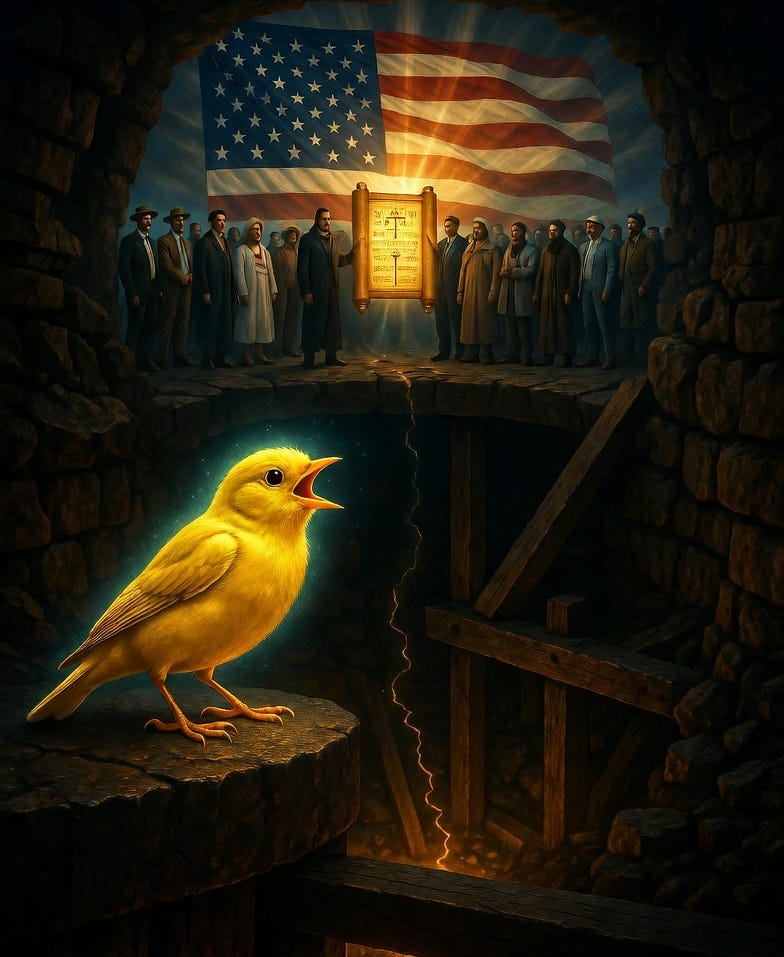
Jews are, in this sense, canaries in the coal mine. Our historical position has given us a sensitivity to specific kinds of danger that people who have never occupied that position are slower to develop. We notice the early signals. We recognize the patterns before they become undeniable. We have seen where certain kinds of rhetoric lead, where certain kinds of institutional erosion lead, where certain kinds of redefinition of membership lead — because we have been the people those processes were turned against, repeatedly, across civilizations that each believed they were different from the ones that had come before.

|
"He's an Anti-Zionist Too!" cartoon book (December 2024) PROTOCOLS: Exposing Modern Antisemitism (February 2022) |
 |
 Buy
Buy