

Preface: The Moment Demands It
The occasion of America’s 250th anniversary is the perfect time to take stock.
The United States has done a great deal that is amazing and it is a magnificent achievement. Yet if we want it to navigate the next 250 years successfully, we need to take a view of where we are at,where we are going and what we can do, today, to keep the American experiment a success.
America at 250 is, by any honest accounting, a remarkable nation. While we see plenty of criticism from the rest of the world, people vote with their feet, and the number of people wanting to become citizens vastly outnumbers those who want to leave. Across the world, in circumstances ranging from desperate to merely uncomfortable, human beings make the calculation that this is the place to live — where effort connects to outcome, where identity does not foreclose opportunity, where the law applies to the powerful as it applies to the powerless, where a person can arrive with nothing and become something. That calculation, made by millions of people with no stake in American self-congratulation, is the most reliable measure of American greatness available.
The evidence beyond the immigration line is equally striking. America’s economy, despite every prediction of decline, remains the largest and most innovative in human history. Its military underwrites the security of allies on every inhabited continent. Its culture — its music, its films, its language, its technology — saturates the world in ways that would have seemed like imperial fantasy to any prior civilization. Its foundational documents remain the template against which other nations measure their own constitutional aspirations. When human beings imagine political freedom, they reach, more often than not, for the vocabulary America invented.
Why? What makes America special? And, more importantly, how can it stay that way?
Every great civilization in history believed its greatness was self-sustaining. Every one of them was wrong. The Roman Republic did not collapse because Romans stopped being talented or energetic or capable of great things; It collapsed because the structural features that had made it great — the balance of powers, the civic culture, the obligations of citizenship — were eroded gradually, then suddenly, by forces that understood how to use the republic’s own language against it. The language of freedom was invoked to concentrate power. The language of tradition was invoked to destroy the norms that tradition had built. The citizens who might have stopped it were not paying sufficient attention, or did not understand clearly enough what was being lost, or had been persuaded that the erosion was actually progress.
We are not Rome. But we are not immune to the dynamics that ended Rome.
This series is an attempt to do three things. First, to understand precisely what makes America great — not in the vague language of inspiration and ideals, but structurally, specifically, in terms of the founding design that produced 250 years of extraordinary results. Second, to name what threatens that greatness today — from the left and from the right, from forces that use the language of American values to undermine American values, from a civic culture that has forgotten what citizenship requires. Third, to map what faithfulness to the founding vision demands in a world the founders could not have imagined — a world of global supply chains and social media and weapons of mass destruction and challenges to democratic governance that were not imaginable in 1776.
The argument centers on a single concept: covenant. In this context, covenant is the specific kind of agreement that defines membership by what you accept rather than what you are. America was the first nation in history to make this covenant the explicit basis of national membership, open to anyone willing to accept its terms regardless of their race or religion of what they believe or where they came from, That founding move — radical in 1776, still not fully understood in 2026 — is what produced everything else worth celebrating about the American experiment.
The analytical tools I use throughout this book come from a framework I have created called Derechology. “Derech” in Hebrew means a path that applies to people and nations as well as geography. America has a derech and it is worthwhile to examine it and see whether it is still consistent with its derech when it was conceived twelve score and ten years ago. Readers who want to understand the framework more fully will find it discussed in an appendix. Everyone else will find it doing its work quietly throughout the text.
Benjamin Franklin, at the 1787 Constitutional Convention, was asked what kind of government had been produced: His answer was, “A Republic, if you can keep it.” A nation does not run on inertia. It requires constant energy to stay the course. Roads require maintenance; without upkeep they decay. The same goes for derech.
The 250th anniversary is not a moment for a victory lap. It is a moment for the question every major anniversary demands: do we understand what we have clearly enough to keep it?
This series is an attempt at an answer.
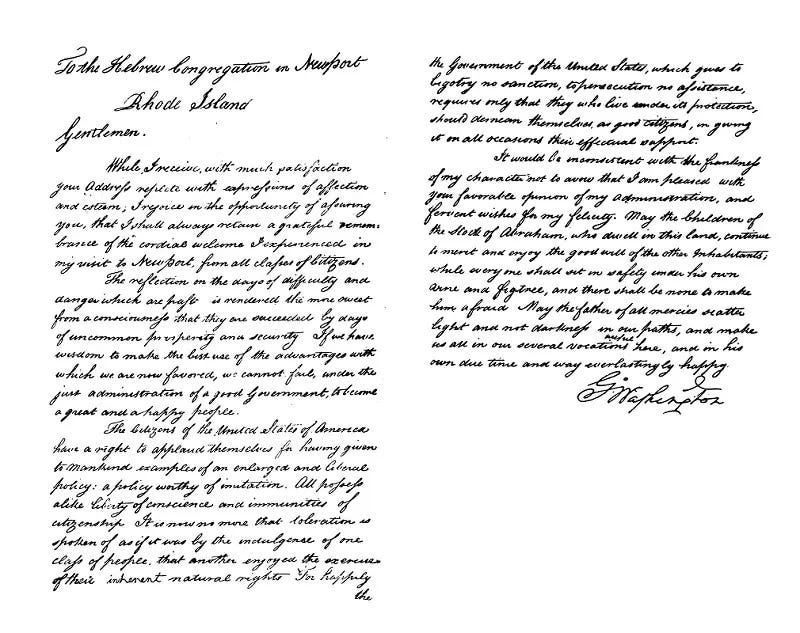
In the summer of 1790, George Washington wrote a letter to the Hebrew Congregation at Newport, Rhode Island. It was the kind of courtesy letter a new president writes to well-wishers who have sent their congratulations. It ran to four short paragraphs. It has been quoted many times in the two centuries since, usually for its famous line about giving “to bigotry no sanction, to persecution no assistance.”
What is interesting is that this was not Washington’s formulation. Washington was replying to the letter of congratulations by the leader of the congregation. Moses Seixas, who used that exact language in his letter. Washington confirmed and adopted this as a key component of the character of the new United States.
But Washington added more that was not in Seixas’ letter, a section that is far more important as a theme of what makes the United States different from all other nations.
Washington wrote, “It is now no more that toleration is spoken of, as if it was by the indulgence of one class of people, that another enjoyed the exercise of their inherent natural rights.”
Washington is not saying that America tolerates Jews. He is saying that the very concept of toleration — the idea that a majority graciously permits a minority to exist — is inapplicable to America at all. Toleration implies a tolerator: someone who holds the power to permit or revoke. This letter says that Jews are full members, on the same terms as everyone else, bound by the same covenant and protected by the same rights. Seixas said this as well in a different way, writing that the US is “deeming every one, of whatever Nation, tongue, or language, equal parts of the great governmental Machine.” But Washington added the idea that the United States would not merely “tolerate” any citizens.
Washington went on to say that equal rights “requires only that they who live under its protection should demean themselves as good citizens, in giving it on all occasions their effectual support.”
For 1790, this is astonishing.
To understand why, look at what was happening to Jews everywhere else in the world at exactly that moment. In France, the Revolution had just emancipated Jews — but emancipation was a grant, a decision by the French majority to extend membership to people who had not previously possessed it. Napoleon would later convene a Grand Sanhedrin of Jewish leaders to ask them formally whether Jews could be loyal Frenchmen — whether, in other words, they could pass the audition for membership in a nation whose membership was defined by French identity.
In Russia, Jews were confined to the Pale of Settlement, permitted to live only in designated territories, subject to laws that applied to them and not to others.
In England, things were better. Jews enjoyed civil liberties like the freedom to worship — but they were not equal citizens. Jews could not sit in Parliament, could not hold most public offices, and could not take degrees at Oxford or Cambridge, because the oaths required for those positions were explicitly Christian, and a Jew could not swear them in good conscience. Jews in England were tolerated in precisely the sense Washington was rejecting.
Across Europe, the Jewish Question — die Judenfrage — was a serious intellectual and political problem, debated across the entire ideological spectrum. Everyone agreed there was a Jewish Question. They disagreed only on the answer.
Washington’s letter dissolved the question before answering it. In a nation where membership is defined by covenant acceptance rather than ethnic or religious identity, “what do we do with the Jews?” has no coherent meaning. The Jews who accept the covenant are exactly the same as every other citizen.
The United States was the first nation since the destruction of the Temple where there was no Jewish question.
Article VI of the Constitution states explicitly that “no religious Test shall ever be required as a Qualification to any Office or public Trust under the United States.”
This was the American difference. On a structural level, America had made a founding move that no prior nation had made: it defined membership not by what you were but by what you accepted. The covenant came first, and the community was constituted by accepting it. Your ethnicity and religion and national origin were irrelevant to your membership.
It was not implemented perfectly for decades at the state level, and we all know that slavery still existed until the Civil War, but the covenant was unique. Even other nations that had similar covenantal language still based citizenship on ethnicity, not acceptance of the covenant itself.
The American Dream was not written in 1776. It was not a founding document or a presidential proclamation. It accumulated — generation by generation, figure by figure — as Americans worked out what the covenant’s logic actually required. Each generation discovered a new dimension of what membership, open to all, defined by acceptance rather than origin, made possible and demanded.
Washington established the principle: membership is inherent, not granted. Lincoln made it non-negotiable. The Civil War was not, at its moral core, a war about states’ rights or economic systems. It was a war about whether the covenant’s terms were real or merely rhetorical — whether “all men are created equal” was a statement of fact the nation was obligated to honor or a pleasant sentiment it could indefinitely defer. The Gettysburg Address reframed the entire enterprise: this was “a new birth of freedom,” not a restoration of the old order, because the old order had breached the covenant from its first day. Lincoln’s contribution to the Dream was to establish that the covenant corrects itself — that the breach creates an enforcement obligation, and that enforcement, however costly, is not optional.

|
"He's an Anti-Zionist Too!" cartoon book (December 2024) PROTOCOLS: Exposing Modern Antisemitism (February 2022) |
 |
 Buy
Buy