
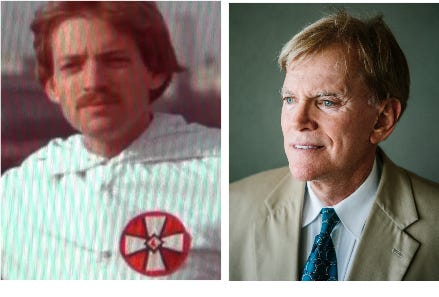
In October 2008, NPR’s Tell Me More invited David Duke on air to discuss the approaching Obama election. The host introduced him carefully — former grand wizard of the Ku Klux Klan, former Louisiana state representative, president of something called the European American Unity and Rights Organization — and warned listeners that what followed might be offensive. Then she asked him how he felt about being called a white supremacist.
Duke rejected the label immediately.
First, I should say that I am not a white supremacist. I don’t think any race should be supreme or rule over another. I do believe in equal rights for all. I just think today that European-Americans face a racial discrimination called affirmative action and the European-Americans have the same right to defend their heritage and their perceived interest as black people do in NAACP, which is not the National Association for the Advancement of People. It’s the National Association for the Advancement of Colored People, that Mexicans do in La Raza, which means The Race, and the advancement - and of course, there are hundreds of organizations that defend and support the perceived interest of the Jewish community, in fact, the foreign nation of Israel.
I would say, I was a white civil-rights activist.
I think that I’ve got the same right to preserve my heritage and my rights that black people have, that Jewish people have and all the groups that work for Jewish interest, that Mexicans have. And I think unless we stand up and do that, we’re going to lose our rights and we are losing our rights in this country.
He was careful about terminology throughout. He did not say “white people,” he said “European-Americans” — a construction that mirrors “African-Americans,” “Mexican-Americans,” or “Asian-Americans.” Every other hyphenated group had organizations, advocacy, institutions. Why not his? He said he was not asking for supremacy. He was asking for parity, for the same rights every other group already had. He had no objection to black schools oriented toward black students, black neighborhoods, black institutions. He simply wanted the same freedom for white communities — to associate, to organize, to define what their community looked like without being called racist for it. People naturally chose to associate with their own kind, he observed. Look at any cafeteria. This was not pathology. It was human nature.
In this way, Duke pre-empted the usual objections to his beliefs. If you call him a racist: he has already rejected that label on principled grounds and invited you to explain what principle distinguishes him from the NAACP. If you say his organization is hateful: he responds that he supports the same freedom of association for every group. Invoke his KKK history: he will note that what he advocates now is equal rights.
Now you are on a debate stage opposite David Duke. He has just said all of this. The camera is on you. Can you refute him? How?
Your disgust at him is not an argument. Duke was arguing dispassionately. How can you respond?
The sad fact is that most people are not equipped to answer Duke’s argument on their own. This should alarm us.
The Duke example is worth examining carefully.
Notice that almost every individual claim he made is defensible on its face. The NAACP does advocate specifically for black Americans. La Raza does mean The Race. Affirmative action does produce outcomes in which some qualified white candidates are passed over on the basis of race. People do tend, voluntarily, to socialize with others like themselves. These statements y are, in the main, true.
And yet the conclusion those facts are being assembled to support — that a former Klan leader running an organization called the European American Unity and Rights Organization is simply doing what the NAACP does — is not just wrong. It is a conclusion that, if accepted, would require us to abandon almost everything we understand about what racism is and how it operates.
How does that happen? How does an argument built substantially on true claims arrive at a conclusion that is repugnant to almost everyone who hears it? Something is happening between the facts and the conclusion. Something is doing work that the facts alone are not doing. The argument is a structure — a framework — and the structure itself is where the problem lives. But identifying that a problem exists is not the same as being able to locate it, name it, and answer it.
Most people who heard Duke that day could not do that. They felt the wrongness clearly. They could not articulate it. And feeling something is wrong, without being able to say why, is not an argument. It is a reaction. Duke knew the difference, and he was counting on it.
Now consider who is listening to arguments like this one today.
The people who heard Duke on NPR in 2008 mostly had an advantage: they had lived through or grown up in the shadow of the civil rights movement. They remembered, or had parents who remembered, what the language of “heritage” and “community rights” and “freedom of association” had been used to defend within living memory. They had emotional and historical context that functioned as a partial defense, even when it could not be articulated as an argument.
That advantage is expiring. The audience that matters most now — people in their teens and twenties who formed their understanding of the world through social media — did not grow up with that context. For many of them, the civil rights movement is as distant as the First World War. They do not have the emotional baggage. They encounter the argument cold, on its stated terms.
And the argument has gotten more sophisticated. Duke is not the threat. The threat is the twenty-five-year-old with a large following on a short-video platform who has never heard of David Duke, who does not think of herself as racist, who genuinely believes she is talking about fairness and equal treatment and the right of every community to advocate for itself. You can point out that Duke has a history of racist statements as a partial rebuttal, but you don’ thave that ammunition against the TikToker today. She uses the same framework Duke used, without the biography that triggers the alarm. She is articulate. She sounds reasonable. She invokes principles her audience already believes in. She is reaching millions of people who have no idea they are hearing an argument with a history.
What do we expect them to say in response? If we — adults who know the history, who feel the wrongness viscerally — cannot articulate what is wrong with the argument, why would they be able to? What exactly are we expecting them to do with the disgust they are supposed to feel but were never taught to explain?
The honest answer is that we are expecting them to absorb the correct conclusion from the culture around them, to feel what we feel, and to suppress the argument unexamined because the person making it has been socially discredited. That has been the substitute for thinking. It worked, imperfectly, as long as the gatekeepers of social credibility were functioning. The gatekeepers are no longer functioning. The argument circulates without the biography attached, in formats and on platforms designed to reward engagement over scrutiny, to a generation that has every reason to be skeptical of the authorities telling them what to feel.
This is the situation. The argument is out in the world. The tools to answer it — really answer it, in terms that hold up — are not widely distributed. The gap between those two facts is not a political problem. It is a thinking problem, and it exists on every subject, right wing or left wing, not just this one.
This series is about the gap.
It does not argue that any particular political position is correct. It does not tell you what to conclude about affirmative action, or immigration, or any of the other subjects Duke raised. What it does is give you the equipment to examine arguments yourself — to see what a framework is doing, to ask what work is being performed between the facts and the conclusion, to identify what a claim requires to be true before you decide whether it is true.
These are not instincts: they are skills. They can be taught. But before you can develop them, it helps to understand exactly what you are up against..
Let’s start with something trivial. There is no meaningful difference between most branded toothpastes and their generic equivalents. The active ingredients are identical. The fluoride concentration is regulated. The whitening agents are the same compounds at the same concentrations. And yet the branded version costs twice as much and outsells the generic by a wide margin, because a century of advertising has attached feelings — of confidence, attractiveness, professional success — to the brand name, and those feelings arrive before any reasoning about ingredients begins. Nobody sits down and consciously thinks, “I will pay extra for this toothpaste because a beautiful person smiled while holding it in the ad.” The persuasion happens below that threshold. Most reach for the familiar brand, and always have.
This is the least consequential example of a problem that runs through nearly everything you consume.
Edward Bernays — Freud’s American nephew, who built the modern public relations industry and was comfortable calling what he did propaganda — understood in the 1920s that the most effective persuasion never announces itself as persuasion. It does not make arguments you can evaluate. It shapes the environment in which you form preferences, so that by the time you make a choice, the choice feels like yours. He famously helped a cigarette company expand its market by hiring women to smoke publicly in a suffragette parade, framing cigarettes as “torches of freedom.” He did not argue that women should smoke. He attached smoking to a value his audience already held, and let the association do the work.
The industry he founded has had a hundred years to refine these techniques, and it has had access to tools he could not have imagined.
The news you read is shaped by what keeps the publication financially viable, which is advertising revenue, which depends on audience size, which rewards stories that generate strong emotion — outrage, fear, tribal solidarity — over stories that generate careful thought. It is an incentive structure, and it operates whether or not any individual journalist is aware of it. A story that makes you angry keeps you reading. A story that makes you uncertain sends you elsewhere. Uncertainty does not monetize.
The universities that produce the experts quoted in those stories are increasingly funded by foreign governments, corporations, and ideologically committed donors, each of whom has views about which research conclusions are welcome and which are not. The funding does not usually purchase specific results. It purchases environments in which certain questions get asked and certain questions do not, in which certain scholars thrive and certain scholars find their grants dry up. The bias is structural and largely invisible to the people inside it.
The movies and television shows you watch as entertainment are, in part, extended commercials. Product placement is now a significant revenue stream for major studios — Apple, Ford, luxury brands — and the integration is designed to be imperceptible. The hero drives a specific truck. The laptop on the coffee table faces the camera at a consistent angle. You are not watching an ad. You are watching a story in which certain products appear so naturally that your brain files them under “things that belong in a good life” rather than “things someone paid to put in front of me.”
Social media is the most sophisticated version of all of this. The platforms are not neutral conduits for information. They are attention extraction businesses, and their product is your time. Every design choice — the infinite scroll, the autoplay video, the notification, the algorithmic feed — is engineered to keep you engaged as long as possible, because engagement is what they sell to advertisers. They have behavioral data on hundreds of millions of people and machine learning systems that have identified, with extraordinary precision, what content keeps each user’s thumb moving. You have almost certainly experienced the result: you watched one video, and then another appeared that was slightly more extreme, slightly more enraging, slightly more impossible to look away from, and an hour later you were somewhere you did not intend to be, having consumed content no one would have described as your choice.
The algorithm did not ask what you wanted to think about. It asked what would keep you watching. These are not the same question, and the algorithm is very good at answering the one it actually asked.
Step back from the individual examples and the scale of the situation becomes clear. Nearly all the information that reaches you arrives with an attached agenda — to sell you something, to hold your attention, to confirm what your tribe believes, to make you feel something specific. The agenda is usually invisible. It operates through the framing, the selection, the emphasis, the emotional register of what is shown to you, not through explicit argument you can evaluate and reject.
You did not choose most of what you know. You absorbed it from an environment that was itself shaped by interests that had nothing to do with your ability to understand the world accurately.
The information environment has always been imperfect, always been shaped by power and money and ideology. Newspapers, pamphlets and books from the 18th century also pushed political agendas. What has changed is the scale and the precision.
The tools that shape what you think are more sophisticated than they have ever been. The tools available to resist them have not kept pace.
That asymmetry is why David Duke’s approach works — and why it is the least of our problems.
Duke understood something that the most effective persuaders always understand: the most durable influence does not fight against your values. It borrows them. He did not ask his audience to abandon their commitment to equal rights. He assumed it, invoked it, and redirected it. He knew that his listeners had been raised to believe that every community deserves to celebrate its culture, that civil rights language belongs to the dispossessed, that consistency is a virtue. So he built an argument from those bricks, in that language, toward a conclusion those values would normally forbid. The argument was designed to make your own principles work against your judgment.
The devil can cite Scripture for his purpose. Countering that requires something more than knowing the Scripture. It requires understanding how frameworks are built, what they assume, what work they are doing beneath the surface of what they say out loud.
That is what thinking is. Thinking is the active examination of what an argument is actually doing: where it came from, what it requires, what it leaves out, why it is reaching you in this form at this moment. It is the difference between being moved and understanding why you are being moved.
It is hard work. It gets easier with practice. And there is no version of self-governance — personal or political — that does not require it.
This series will give you tools to recognize the persuasion methods and understand how falsehood can be smuggled into things that sound true. Each tool addresses a specific way that arguments fail, or a specific way that our own thinking fails when we encounter them. Together they constitute a method for doing something to what you read rather than having it done to you. It is easy to let a rally or a song or an article or a novel wash over you and influence your thinking. It is easy to go along with the crowd. It is difficult to recognize how you are being manipulated in real time.
The tools are only useful if you apply them without exemptions — to your own side’s arguments as rigorously as to the opposition’s. That is harder than it sounds, because we all have biases.
Thinking is hard. But it is very rewarding.
Let’s start.
|
Reclaiming the Covenant on America's 250th (May 2026) "He's an Anti-Zionist Too!" cartoon book (December 2024) PROTOCOLS: Exposing Modern Antisemitism (February 2022) |
 |
 Buy
Buy