

If you join my paid tier on Substack, you can access all the individual essays as they are posted over the next few days and the complete Haggadah PDF before Passover. For those who subscribe to EoZ here paying $5 or more per month, I cannot automatically send you the PDF but if you email to me I will try to send it to you before the holiday.
Here is a sample essay.
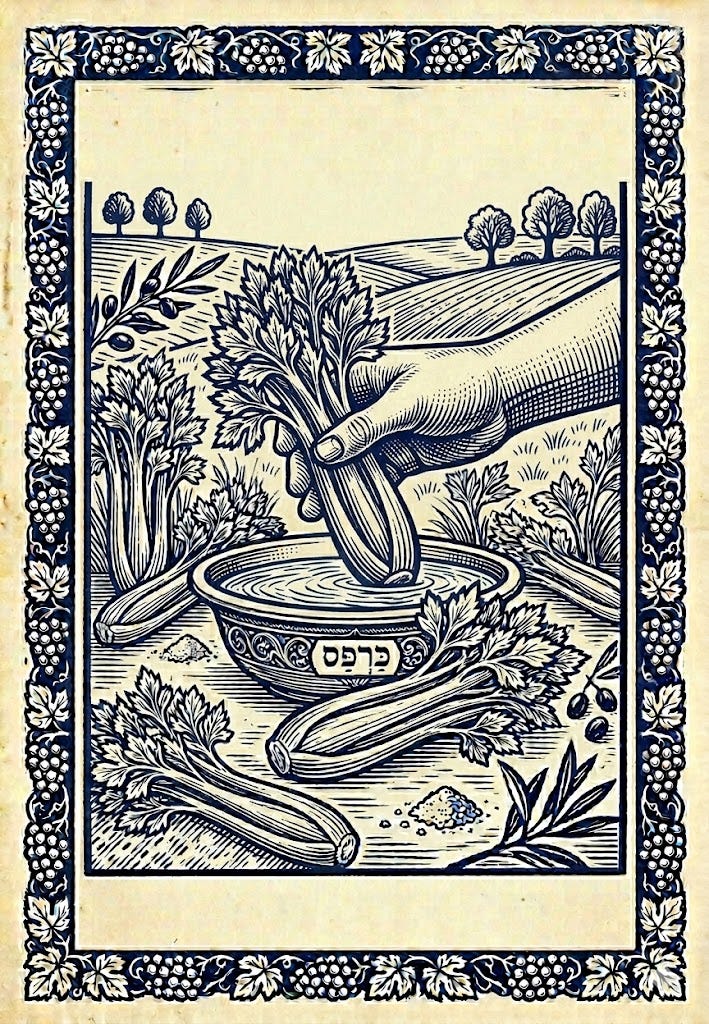
כַּרְפַּס — Karpas: Why Hasbara Fails
The Haggadah does not explain what dipping the greens into salt water means. Before we discuss our slavery in Egypt, we say the regular blessing over vegetables, dip them, eat a little – and that’s it.
Of course there are commentaries that explain it. The salt water represents tears. The vegetable represents the initial promise of Egypt — Joseph’s rise, the welcome his family received, the children of Israel settling in the fertile land of Goshen. What began as abundance ended in the tears of slavery and grief.
We haven’t said a word about the Passover story yet. We have not yet discussed Egypt or Pharaoh or the plagues. And yet here, before the narrative begins, without any explanation in the text, we taste the tears of our ancestors.
The sequence is deliberate: we experience the emotional truth of the story in our bodies before we encounter it in words.
Modern Jews tend to intellectualize. When faced with hostility to Israel or other antisemitism, our instinct is to reach for the argument — whether it is the historical record, the legal case, or the moral comparison. The assumption is that people are essentially rational, and that if you present the facts clearly enough and the logic is sound, minds will change. This assumption is almost entirely wrong, and its failure has a name: hasbara.
The research on how people actually form and change beliefs is unambiguous and humbling. Most people do not reason their way to their positions — they feel their way there first and then recruit reasoning afterward to justify what they already believe. Emotion precedes cognition. The body registers before the mind processes. Arguments that arrive without emotional grounding do not usually persuade. For people who have already become emotionally wedded to a narrative, when presented with facts that prove them wrong, they tend to double down on their beliefs. Psychologists even have a name for this: the “backfire effect.”
The authors of the Haggadah understood this with remarkable clarity. They did not open the Seder with the theological argument for why the Exodus matters, or the historical evidence that it occurred, or the philosophical case for Jewish peoplehood. They opened it with a taste of salt water on the tongue. The body is enrolled before the mind is asked to engage. By the time the arguments come — and they come in abundance in Maggid — the person at the table has already been moved. The intellectual grounding lands in soil that has been prepared to receive it.
None of this is anti-intellectual. The Haggadah is one of the most intellectually dense texts in the Jewish canon — full of debate, exegesis, competing interpretations, and deliberate provocation. Truth matters enormously. But truth that is only argued and never felt reaches only the people already disposed to accept it. The rest need the salt water first.
We cannot understand slavery by reading about it from a comfortable distance. We cannot transmit the experience of persecution through a PowerPoint presentation. We cannot make people care about Jewish history by reciting it at them. We must find ways to make it felt — in the body, in the imagination, in the gut — before we make the case in the mind.
We dip before we read. We taste before we tell. The tears come first.

|
"He's an Anti-Zionist Too!" cartoon book (December 2024) PROTOCOLS: Exposing Modern Antisemitism (February 2022) |
 |
 Buy
Buy